Orientation
Executive Summary#
The North American grid now absorbs the fastest load growth in decades. Within the last twelve months, the major North American reliability institutions that govern it — FERC, NERC, and the RTOs/ISOs — reached the same conclusion: the rules written for a flat-demand system are no longer sufficient for today’s pattern of large-load growth. A single customer can now request more power than a mid-sized city. The available data indicate a substantial mismatch between projected load growth and infrastructure development timelines.
The scale of the problem#
ERCOT now tracks more than 438 GW of large-load interconnection requests — roughly five times the all-time system peak of 85.5 GW — with close to 90% of that volume coming from data centers. Over the same period it approved on the order of 2.2 GW to energize, and about 9 GW cumulatively as of April 2026 — two different quantities, and the report uses both. (ERCOT notes that its own 438 GW queue figure carries duplicate and speculative requests — see Section 1 — so it indicates pressure rather than demand.)
Why existing rules no longer fit#
ERCOT is not alone in recognizing the problem. In responding to FERC’s June 18 order, MISO indicated that its tariff provides no consistent or transparent framework for evaluating large loads — an admission that carries particular weight because MISO has seen the fastest data-center growth of any region. FERC staff put that growth at 43% compound annual growth since 2020 in the 2025 State of the Markets report of March 19, 2026, against 24% nationally over the same period, and the Commission repeated the finding in the June 18 orders. Every use of the figure in this report draws on that one dataset. The queue-integrity problem is therefore not a Texas peculiarity arising from ERCOT’s connect-and-manage model. It appears wherever load growth outruns the processes built to evaluate it.
Capacity-market outcomes point in the same direction. PJM's Base Residual Auction cleared at $28.92/MW-day for the 2024/25 delivery year, then at $269.92 for 2025/26, $329.17 for 2026/27, $333.44 for 2027/28 and $325 for 2028/29. Two of those auctions fell in 2025 because PJM was compressing its schedule back toward a three-year-forward cycle, so the series covers five delivery years rather than five calendar years. The last three cleared at the price cap in force at the time, and the nominal decline in the most recent one reflects the extended collar rather than any supply response. PJM's independent market monitor attributes roughly 40–45% of recent capacity-auction cost to data-center load, most of it not yet built.
Reliability data are consistent with the same conclusion, and this is the part of the problem least represented in public debate. NERC has documented disturbances in which about 1,500 MW of computational load disconnected itself in response to a fault that never threatened it, and ERCOT has recorded 26 further events above 100 MW between January 2023 and September 2025. These are not outages in the ordinary sense: no equipment failed, protection operated exactly as designed, and the load left anyway. The consequence is that a single customer class can now produce contingencies approaching the loss of a large generating unit. ERCOT has therefore reduced operating limits on some interfaces, and NERC issued its most serious non-standard instrument, a Level 3 alert, in May 2026.
Some headline figures in this report come through trade press or analyst summaries rather than from the filing itself. Where such a figure carries weight, the text says where it came from and notes any dispute about it, both at the point of use and in the References.
This report isolates the eight issues that dominate the record and treats each in its own section. The first four concern the physical and financial system: (1) queue congestion and speculative load, including how load forecasting turns requests into planning numbers; (2) the resource-adequacy and development-timeline gap; (3) cost allocation and cost-shifting to existing ratepayers; and (4) large-load ride-through and dynamic performance. The remaining four concern the terms on which load connects: (5) co-location, behind-the-meter generation, and electrically proximate load; (6) flexible and curtailable load service, the one issue that also supplies the leading solution to several of the others; (7) the federal-state jurisdictional divide, which determines whether anyone holds authority to impose the first six; and (8) off-grid and islandable load, where on-site supply shifts the system impact rather than eliminating it.
A final section (9) sets all of this on a single 2018–2035 timeline — the actual decisions of each institution alongside the proposed and projected milestones — to show how the reforms and the reliability risks run on different clocks. Four structural observations run through all eight:
- Load now behaves as a dynamic bulk-system element rather than a passive boundary condition. AI and crypto facilities ramp, oscillate, and trip. The planning and standards framework still treats load as an inert P-Q injection, and NERC has said explicitly that this is inadequate.
- Time remains the principal constraint, and demand flexibility appears to offer one of the few responses that operate on comparable timescales. Every serious proposal — SPP's high-impact large-load (HILL) process, PJM's non-firm service, ERCOT's Controllable Load Resource pathway, MISO's expedited-study routes (ERAS/EPR) — trades some firmness for a faster energization date.
SPP has since taken the further step. On June 5, 2026, FERC accepted Conditional High Impact Large Load Service (CHILLS), which offers large loads long-term transmission service ahead of the upgrades normally required, conditioned on the load accepting curtailment and on separate telemetry and billing that expose its real-time draw to the operator. A load that exceeds a declared cap may be curtailed. CHILLS is the closest thing in force to the bounded, priced, predictable curtailment product this section identifies as the missing instrument — and the first place to look for evidence on whether developers will actually accept one.
- The regulatory posture shifted from study to compliance filing in June 2026. FERC's six simultaneous Section 206 show-cause orders put every RTO on a 60-day clock, with responses due August 17, 2026. That date held nowhere. All six operators moved for the ninety-day abeyance the orders allow — PJM on July 28, the other five on August 3 — and the Commission granted the motions at the ninety-day cap, moving the substantive responses to November 16, 2026, November 20 in SPP. No region defended its tariff on the original schedule; each is instead developing a replacement design in a regional stakeholder process.
- No single institution has clean authority over the problem. FERC can reach the wires but not the retail customer; the states can reach the customer but not the interstate system; NERC can reach reliability only over entities it first registers. The fragmentation of the remedies follows directly from the fragmentation of the authority.
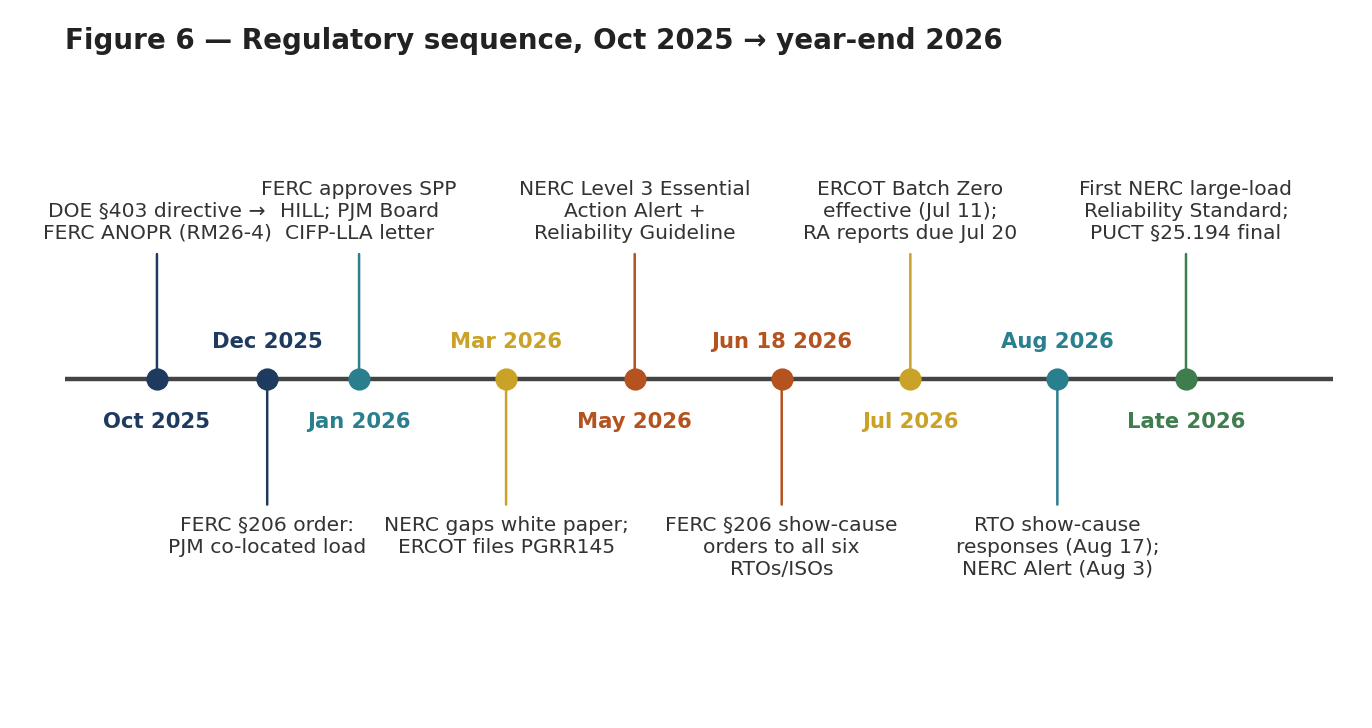
Figure 6 — The compressed regulatory sequence, from the DOE §403 directive through the standards and tariff filings due in late 2026. The interval matters because each step depends on the one before it: registration criteria determine which entities a standard can bind, and a tariff filed before the standard exists cannot reference it. The sequence leaves little slack, so a delay at any point moves every subsequent date rather than compressing the remainder.