Context and synthesis
9. The Long View: A 2018–2035 Timeline of Actions and Decisions#
Why a long horizon matters. The preceding sections are a snapshot of a system in acute stress in mid-2026. But none of it began in 2026, and none of it ends there. The large-load problem is the collision of two multi-year processes — a demand curve that bent sharply upward around 2022–2023, and a regulatory apparatus that moves in three-to-ten-year rulemaking and construction cycles. Placing the two on one axis allows a judgment about whether the 2026 flurry of orders marks a turning point or merely the moment the backlog became visible. This section places the actual decisions of FERC, NERC, the six jurisdictional ISOs and RTOs — PJM, MISO, SPP, CAISO, NYISO and ISO-NE — together with ERCOT and the PUCT, the DOE and the states, on a single timeline from 2018 through 2035, and marks the proposed and projected milestones due over the next decade.
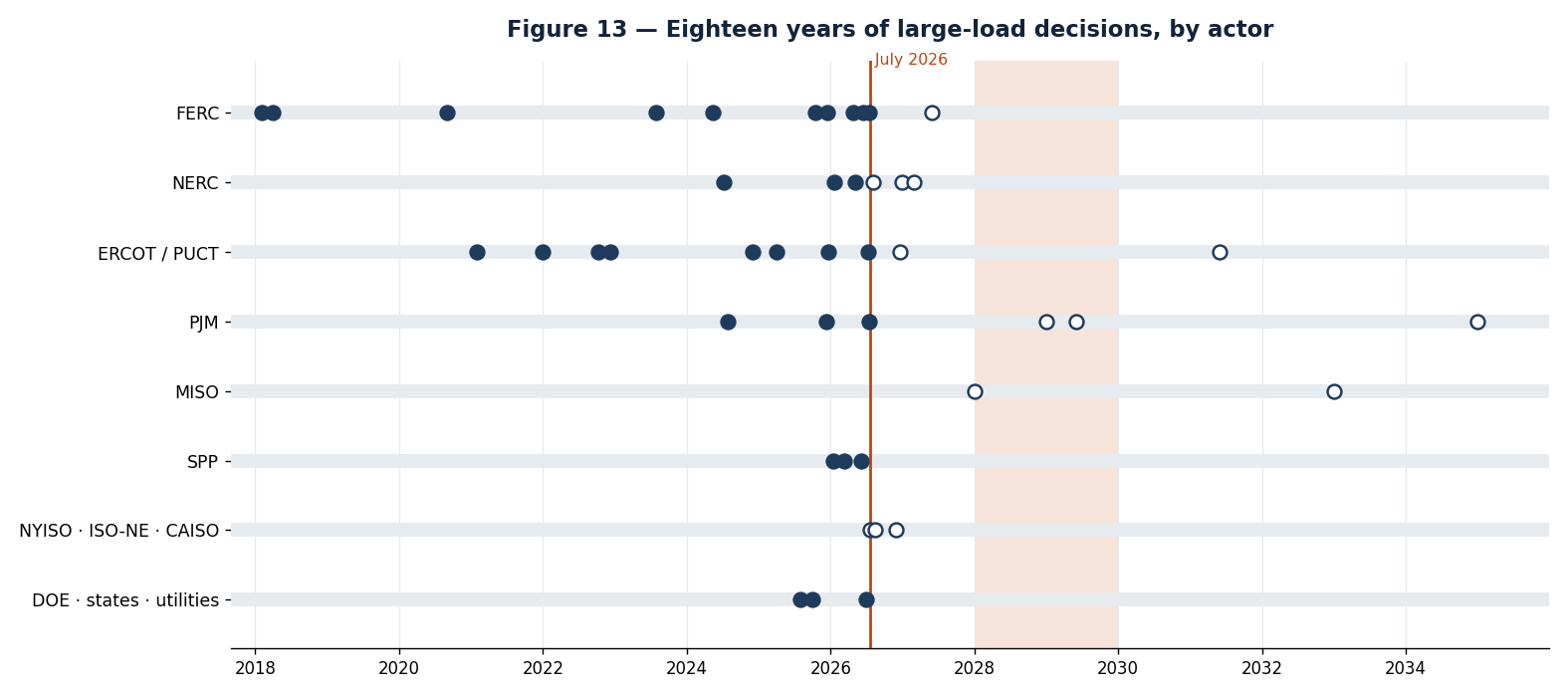
Figure 13 — Eighteen years of large-load decisions, by actor. Each row is one decision-maker; solid markers record actions that have occurred, hollow markers scheduled compliance dates, proposals, and projected onsets. The vertical rule marks July 2026 — everything to its right forecasts rather than commits. The shaded band covers 2028–2029, the years NERC’s assessment marks as the onset of elevated shortfall risk in MISO and PJM, which fall before most of the remedial standards become enforceable and well before the extra-high-voltage transmission is energised.
The 2025–2027 window carries most of the action and is hard to read at full scale, so Figure 14 expands just that stretch — the same events, labelled individually, with room to separate them.
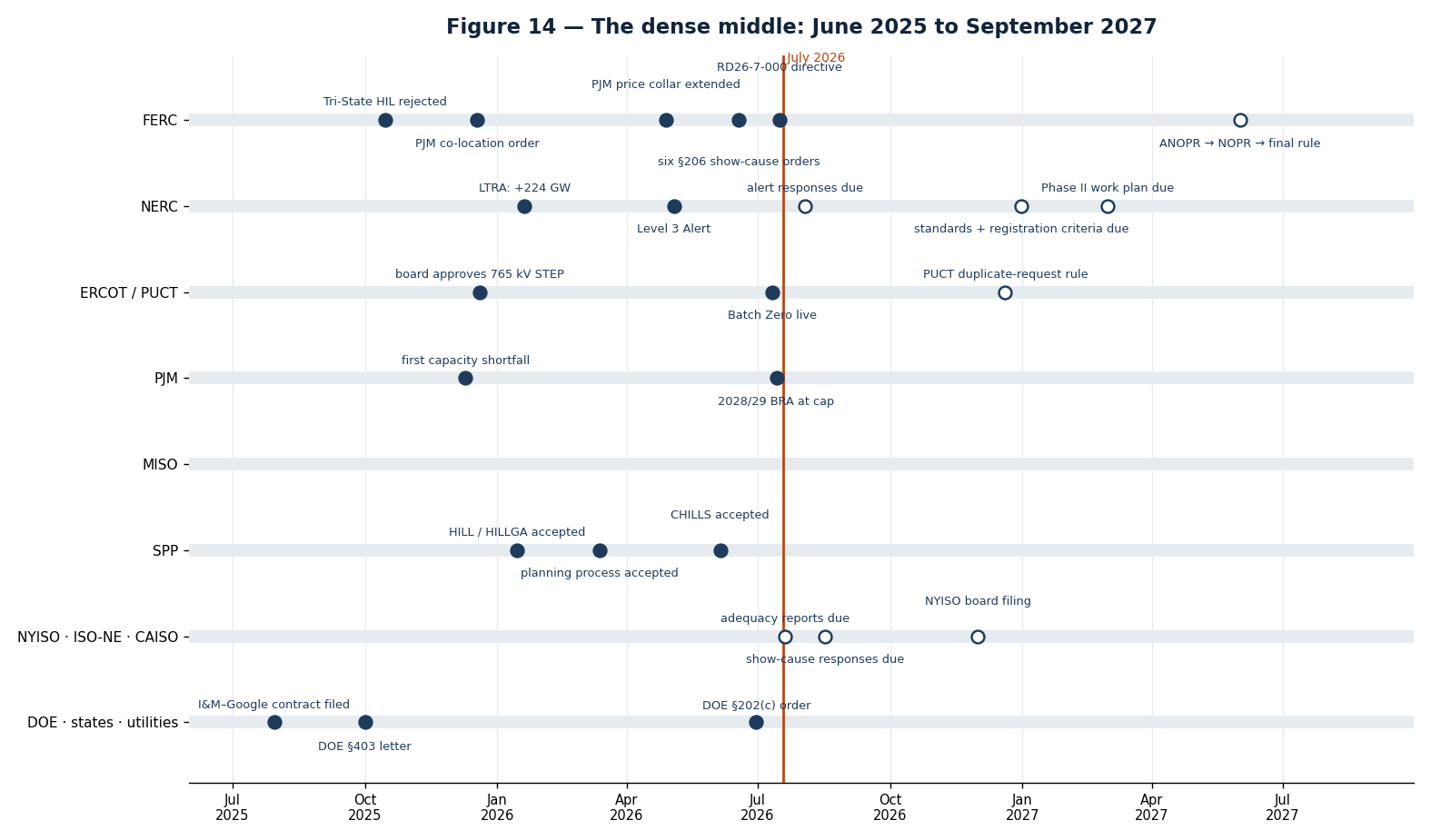
Figure 14 — The dense middle, June 2025 to September 2027. The same events at expanded scale, with every marker labelled. The concentration of completed actions to the left of the July 2026 line, set against the scheduled and proposed items to its right, states the section’s argument visually. The actors front-loaded the response, and the binding compliance dates all fall after it: the show-cause responses, moved by abeyance from August 17 to November 16, the December 31, 2026 NERC standards and computational-load registration criteria, the PUCT duplicate-request rule, and NYISO’s own board filing.
2018–2023: the foundation laid for a different problem#
The rules that govern large-load integration today were mostly written to solve the opposite problem — connecting supply, not demand. FERC's Order No. 841 (February 2018) opened wholesale markets to electric storage; Order No. 845 (April 2018) reformed the generator interconnection process; Order No. 2222 (September 2020) brought distributed energy resource aggregations into the markets. The generation-side queue reform that everyone now cites as the template for load, Order No. 2023, issued July 28, 2023 and took effect that November — mandating cluster studies, readiness deposits, and “first-ready, first-served” processing. In parallel, the shock of Winter Storm Uri (February 2021) reset ERCOT's and NERC's cold-weather and reliability agendas. The demand signal was already building underneath all of this: ERCOT stood up its Large Flexible Load Task Force in 2022 to cope with a cryptocurrency-mining boom that was the leading edge of the load wave now dominated by AI.
2024–2026: the year and a half when load became the story#
The pivot is visible in the density of the timeline. FERC issued Order No. 1920 (May 13, 2024) on long-term transmission planning and Order No. 1977 on siting. NERC's July 10, 2024 Northern Virginia event — about 1,500 MW lost to a fault the load rode through badly — became the archetype the entire 2026 reliability program is built around — and the same signature returned at more than twice the scale on July 22, 2026, after that program was already under way. Then the cascade, in four registers. Markets moved first: PJM's capacity price spike in the July 2024 auction, and its first-ever capacity shortfall in the December 2025 auction. Planners followed: ERCOT's 2024 Regional Transmission Plan (December 2024) with its dual 345 kV and 765 kV builds, and NERC's Long-Term Reliability Assessment raising the ten-year peak forecast by 224 GW (January 2026). Then the federal instruments: DOE's Section 403 letter to FERC (October 2025), FERC's PJM co-location order (December 18, 2025), FERC's six show-cause orders (June 18, 2026), and DOE's Section 202(c) emergency backup-generation order (June 30, 2026). And finally the operating rules: NERC's Level 3 Alert and Reliability Guideline (May 2026), and ERCOT's Batch Zero going live (July 11, 2026). Eighteen months carry more consequential large-load actions than the prior six years combined.
One distinction has to be held firmly here, because the two problems are routinely merged. What the chip and rack designs described in the annex address is ramp volatility — the periodic, synchronised swing of a training cluster and the oscillation band it emits. What both archetypes in this section are is something else: an uncommanded disconnection, protection acting on a fault the system cleared normally. Nothing in a power shelf changes a relay setting. So the hardware does not answer this section's case, and the ride-through obligations do not become redundant because the silicon improved. What the hardware does change is the target the modelling and oscillation work is aimed at: NERC is drafting against measured 2024–26 behaviour, while the load arriving in 2028 will be built on equipment designed to emit less of it. That is this report's timing inversion running for once in the helpful direction, and it argues for writing the standard in terms of the behaviour required at the point of interconnection rather than the equipment assumed behind it.
2027–2035: what is scheduled, proposed, and feared#
The right half of the timeline necessarily softens, but it holds real content. Several items are concrete compliance targets: PUCT's duplicate-request rule falls due by December 2026; NERC's Project 2026-02 should produce a “bridge” Reliability Standard by the end of 2026, with broader standards drafted from 2027 and a computational-load registry following. As of FERC's July 16, 2026 order in RD26-7-000 those NERC dates no longer represent a schedule NERC set for itself: the standards and the registration criteria are both due December 31, 2026, and a Phase II work plan for further standards is due March 1, 2027. On the demand-and-market side, PJM's second consecutive capacity shortfall (2028/29 BRA, July 14, 2026) is the first hard market evidence that the adequacy gap the right half of this timeline anticipates is materialising. FERC's ANOPR is widely expected to mature into a NOPR and then a final rule across 2027, with co-location and flexible-load service terms taking effect thereafter. Others are projections rather than plans, and they are where the risk concentrates: NERC's 2026 Long-Term Reliability Assessment places PJM in a high reliability-risk category beginning around 2029 and MISO from roughly 2028, as demand outruns resource additions. The long-lead physical builds anchor the far end — ERCOT's 765 kV backbone is a late-decade-into-2030s project, and PJM's and MISO's own forecasts run to summer peaks near 210 GW and demand additions of 18 GW of data-center load, respectively, by 2035. Above all the timeline shows a timing inversion: the reliability-risk windows (2028–2029) arrive before most of the remedial standards are enforceable and long before the major transmission is energized (early 2030s). The regulatory timeline trails the physical one, and on the current schedule the physical constraints arrive first. The inversion is more usefully described as four clocks running at different speeds than as a single race between “policy” and “physics.” Load is the fast clock (Section 2's eighteen-months-to-three-years); equipment, wires, and the rules themselves are the slow ones, the last a NOPR-to-enforceable-standard cycle measured in years. The report's thesis is simply that the first clock now outruns the other three. What makes the gap durable is that two exogenous forces set the speed of the slow clocks, and neither is a grid-engineering problem the sections above can solve.
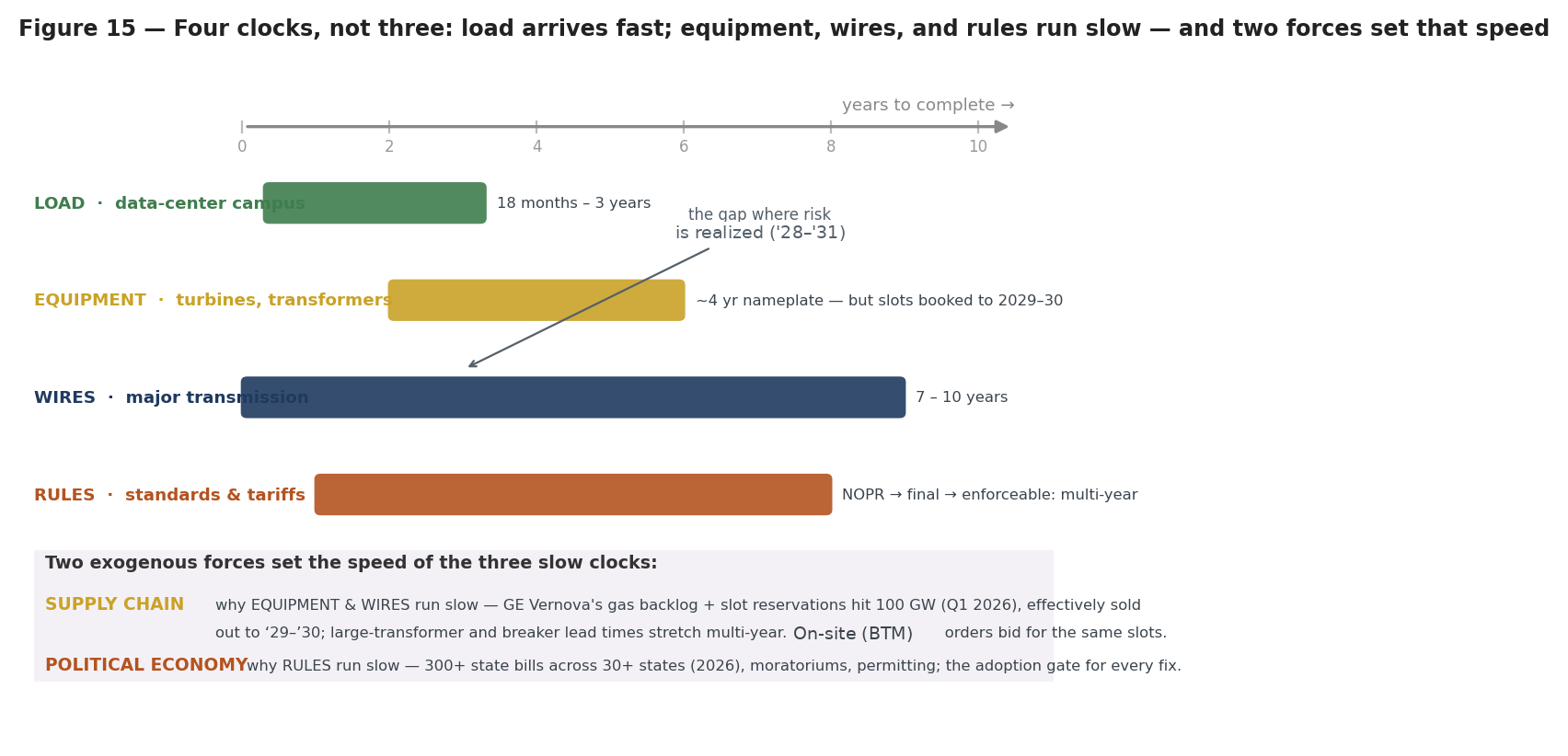
Figure 15 — The timing inversion as four clocks. Load moves fastest; equipment, wires, and rules move slowly, and supply chain (equipment and wires) and political economy (rules) set the pace of the three slower clocks. The stress lands in the gap, roughly 2028–2031.
The first force is supply chain, which sets the equipment and wires clocks. On the order-book evidence in Section 2, gas-turbine manufacturing rather than developer demand appears to be the binding constraint — Section 2 details the backlog that has booked slots to the end of the decade, which suggests the “four years for generation” figure is optimistic. Two consequences matter for the timeline. First, the on-site alternatives do not avoid the bottleneck: a behind-the-meter turbine order (Sections 5 and 8) competes for the same scarce slot as a utility's grid-serving order, so on-site generation bids against the grid rather than stepping outside it, and may widen the adequacy gap it was intended to address. Second, it explains why flexible load (Section 6) outranks every other near-term lever: it adds no equipment to the queue, so scarcity only raises its value.
The second force is political economy, which sets the rules clock. Section 7 details the wave of state legislation — 300-plus bills, separate rate classes, and a growing minority of moratoriums — that is writing the jurisdictional map in real time. It bears on the timeline directly: political economy governs adoption of nearly every fix in Sections 1–6, because “but-for” cost assignment, minimum-take tariffs, and exit fees are set by public-utility commissions under political pressure rather than by engineers, and a moratorium can freeze a market no matter how well its tariff is written. The rules clock moves slowly not because the drafting is difficult but because the politics are — and the permitting and local-opposition gate (Sections 7 and 8) can stop a project before any tariff applies.
Both forces feed back into the Section 1 thesis rather than sitting beside it. The interconnection queue reflects optionality as much as demand, and scarce turbine slots produce the same behavior, GE Vernova's 56 GW of slot reservations represent the equipment-side analogue of speculative queue entries — positions held for option value that may never convert. Divergent state tariffs and moratoriums push developers to arbitrage across jurisdictions exactly as they arbitrage across points of interconnection.
Neither supply chain nor political economy constitutes a ninth or tenth problem. The report identifies eight, and these are not additions to that list. They are two further venues in which the same speculation problem plays out, and they compound one another: a turbine backlog and community opposition jointly close the off-grid door, while ratepayer politics and long-lead transformers jointly sharpen the stranded-cost fear behind the AEP example in Section 3. The practical consequence for a reader is that neither force can be delegated. A remedy for any of the eight problems that assumes equipment arrives on schedule, or that a commission will approve the tariff supporting it, has not been assessed against the two conditions most likely to defeat it.