Orientation
The Large-Load Interconnection Process: Where the Eight Problems Arise#
The eight issues treated in this report arise at identifiable points in a single sequence that runs from a customer's request to the tariff and operating limits that govern the load once it is energised. Table K1 sets that sequence out, with what each step decides, what this report finds going wrong there, and where the matter is treated. It is the shortest complete statement of the report's argument: the steps are conventional and well understood, and the difficulty is that gigawatt-scale computational load violates assumptions embedded in several of them at once.
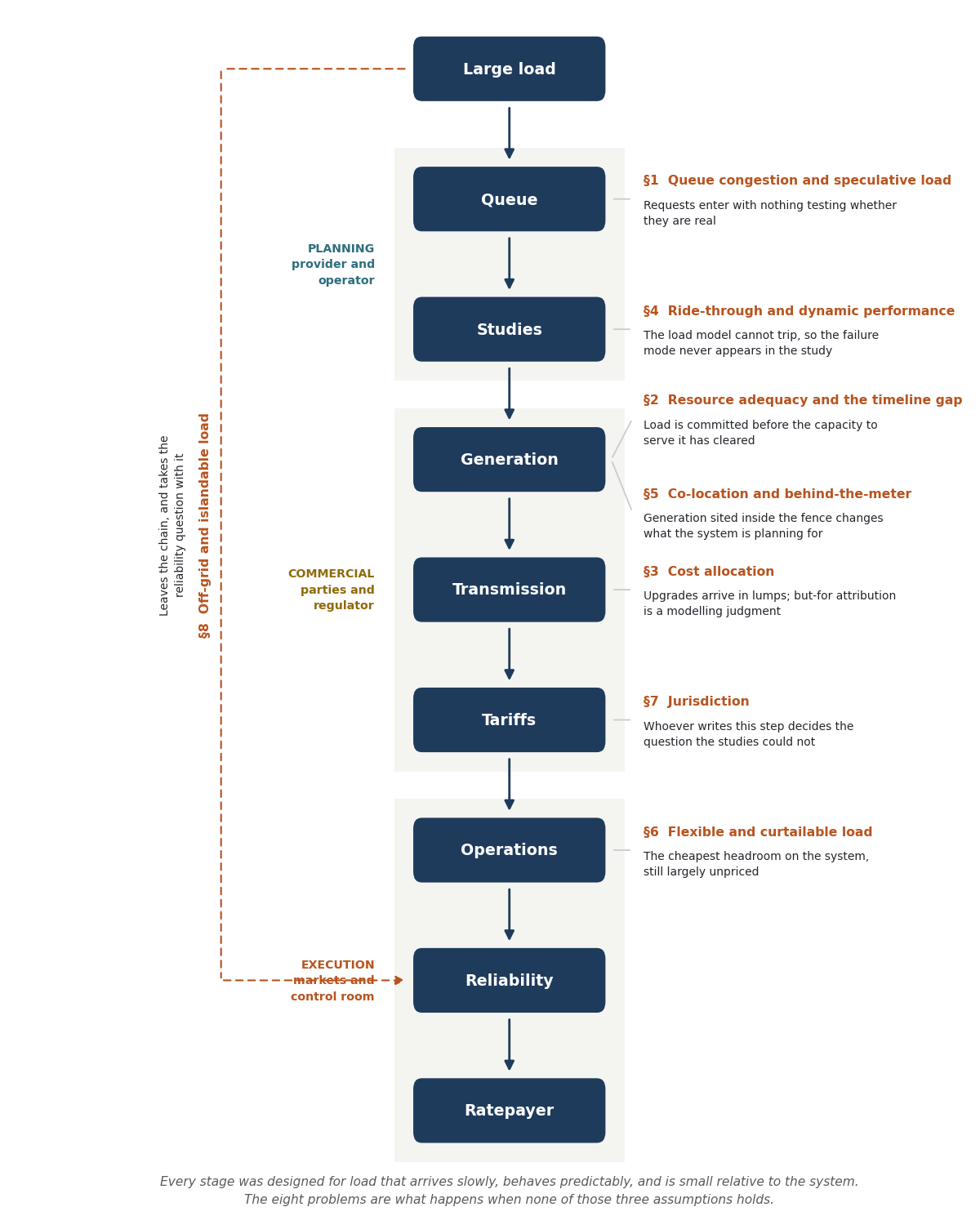
Figure K1 — The chain, and where each problem attaches. One spine runs from the customer's request to the ratepayer who ultimately pays for it, banded by the three institutional phases: planning belongs to the transmission provider and the operator, commercial to the parties and their regulator, execution to the markets and the control room. Seven of the report's eight sections attach to the stage where their problem arises. Section 8 is drawn as a dashed bypass because that is what going off-grid is — leaving the chain, and taking the reliability question along with it rather than resolving it. The stages are unremarkable in themselves; what fails is the assumption each was built on.
| Step | Engineering question | Large-load problem | Sections |
|---|---|---|---|
| **Planning** — the transmission provider and the operator | |||
| Load request | How much capacity, where, and by when? | Nothing tests whether the request is real; duplicate and speculative requests inflate the pipeline and crowd genuine ones | §1 |
| Power flow | Does the network carry the load at peak and under contingency? | Volume overwhelms study capacity; a single peak case and a static load assumption answer a narrower question than the one asked | §1; T.3 |
| Short circuit | Is fault duty at the point of interconnection within breaker ratings? | Routinely screened for generation and overlooked for load, though converter front ends and on-site generation both change the duty | T.3 |
| Transient stability | Does the system stay in synchronism and recover voltage and frequency after a normally cleared fault? | Load represented as static and unable to trip, so the dominant failure mode — uncommanded loss of demand — cannot appear in the result | §4; T.4 |
| EMT | What happens inside the cycle at a weak or converter-dense interface? | Treated as discretionary; vendor models used unvalidated, at settings that may not match what was commissioned | §4; T.4 |
| **Commercial** — the parties and their regulator | |||
| Upgrade list | Which network additions does this request trigger? | Upgrades arrive in lumps and physics shares them, so but-for attribution is a modelling judgment — the point at which cost-shifting begins | §3; T.3 |
| Interconnection agreement | Who pays, on what schedule, under what performance terms? | Written before the standards that would define its performance terms exist; flexibility is left unpriced and the exit is unsecured | §3; §6 |
| **Execution** — construction, markets, and the control room | |||
| Construction | Can the wires be built in time? | Five to ten years against a two-to-three-year data-center build, with transformer and breaker lead times that no tariff shortens | §2; §5 |
| Resource adequacy | Does generation exist to serve the load now committed? | Commitment precedes confirmation: the load is in the forecast and the agreement before the capacity to serve it has cleared | §2; T.6 |
| Tariff and operations | What rates, curtailment obligations, and operating limits govern it? | The residual risk lands here, on ratepayers or on the load, and the choice is made by whoever writes this step rather than by the study that preceded it | §3; §6; §7 |
Table K1 — The sequence, and where it breaks. The three phases matter as much as the ten steps, and each fails differently: the engineering studies by modelling the load wrongly, the commercial agreements by allocating what the studies could not attribute, and execution by running out of time. The eight issues of this report are not eight separate problems so much as ten points on one process, which is why a fix applied at one step is so often undone at another.
Sources: As cited in the sections named in the final column. The sequence is standard practice; the third column states this report's findings.