Section 3 of 8
3. Cost Allocation and Cost-Shifting to Existing Ratepayers#
The issue. Under traditional cost allocation, network upgrades and capacity costs are socialized across the load base, because historically load growth was incremental, broadly distributed, and roughly proportional to the customer base that paid for it. A 1 GW campus challenges many of those assumptions. It arrives lumpy and geographically concentrated, driven by customers whose investment economics differ substantially from those of residential consumers — and under traditional socialized cost allocation, residential customers may bear a portion of the resulting costs.
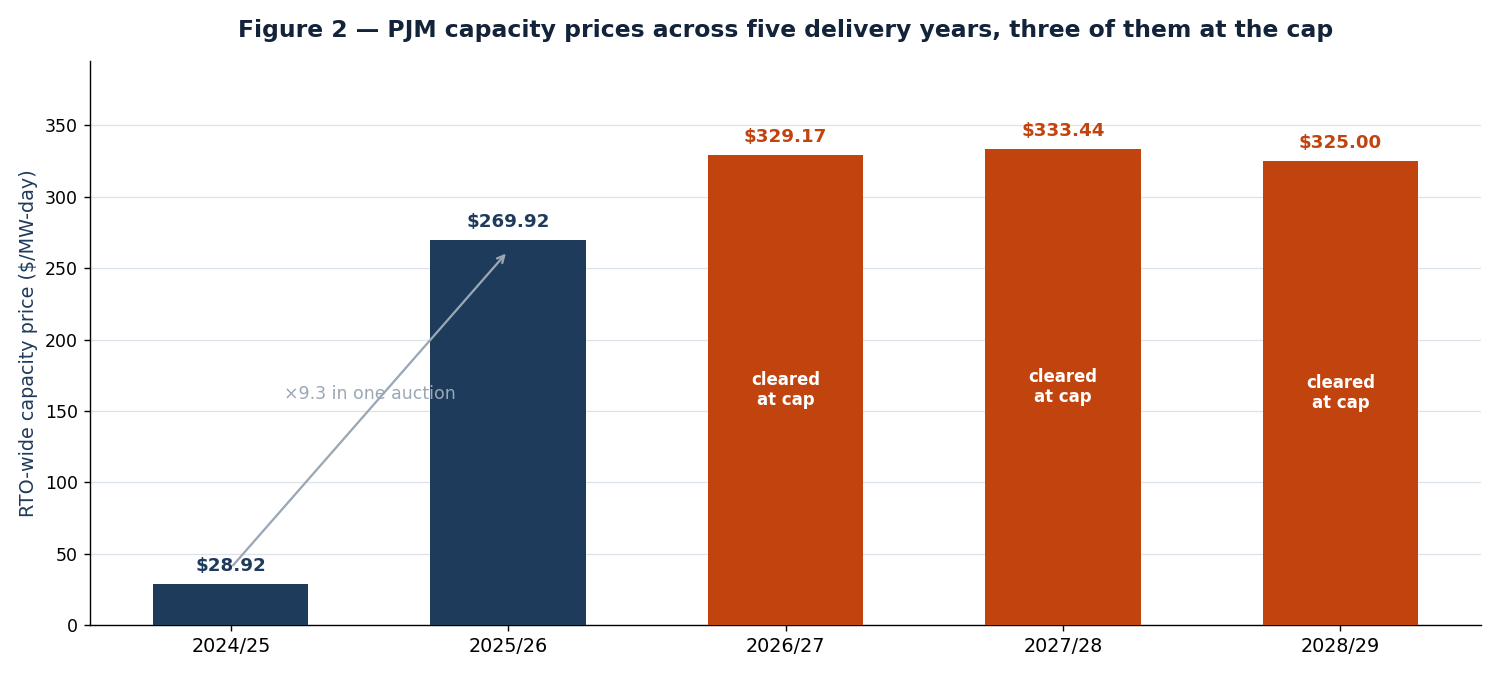
Figure 2 — PJM capacity prices across five delivery years. RTO-wide Base Residual Auction clearing prices. The 2025/26 auction, held in July 2024, raised the RTO price from $28.92 to $269.92/MW-day in a single round. The three auctions since — 2026/27 in July 2025, 2027/28 in December 2025, and 2028/29 in July 2026 — each cleared at the FERC-approved cap in force at the time: $329.17, $333.44 and $325/MW-day. Two of the three fell in the same calendar year because PJM was returning to a three-year-forward schedule. The escalation carries large-load growth through to household bills with essentially no buffer between auction and rate case, and the small decline at the end reflects the extended price collar rather than any supply response.
PJM's Independent Market Monitor found that data-center load accounted for $6.5 billion — about 40% — of the $16.4 billion cost of the December 2025 capacity auction, and that roughly $6.2 billion of that related to data centers that have not been built but could come online by the 2027/28 delivery year. Across the last three base auctions, data-center-related costs above existing data-center load totaled $21.3 billion, or about 45% of $47.2 billion. Forward estimates of the household impact turn on a single assumption — whether the capacity price collar holds. NRDC's September 2025 analysis, the source of the widely repeated $70/month figure, assumed the collar lapsed after 2027/28 and annual capacity costs rose to $27–30 billion, totaling $163 billion from 2028 through 2033; Synapse Energy Economics put the cumulative figure near $100 billion assuming mitigation continued, which implies roughly $40–45/month on the same arithmetic. That premise has weakened since: FERC accepted an extension of the $325/$175 per MW-day collar to the 2028/29 and 2029/30 delivery years on April 28, 2026, and the 2028/29 auction cleared at $16.4 billion rather than the $27–30 billion the higher projection assumed. Measured capacity-attributable increases are smaller and better documented — roughly $16/month in Ohio, $18/month in western Maryland, and about $10 of a $21/month Pepco increase in the District. The $70 figure is best read as the upper bound of a $15–70 range contingent on collar policy after 2029/30, rather than as a central expectation. The 2028/29 auction (July 14, 2026) cleared at the $325/MW-day cap for a third consecutive capped auction, so the escalation in Figure 2 has flattened against the ceiling rather than reversing — the small nominal dip reflects the price collar rather than a supply response. This has become one of the principal areas of policy debate in large-load system expansion, and it is likely to require near-term regulatory attention.
The argument for direct assignment reached the Commission in concrete form well before any of the figures above. Protesting the Susquehanna amended interconnection service agreement in June 2024, Exelon and AEP put the cost shift from that single arrangement at up to $140 million a year, and the exchange that followed shows why the principle proves harder to administer than to state. Their affiants derived the figure by costing 480 MW at a 98% load factor under PPL’s LP-5 retail tariff — that is, by asking what the utility would have collected had the load connected to the distribution system in the ordinary way. Susquehanna answered that this measured forgone revenue rather than any cost actually incurred: PPL had built nothing for the arrangement, so no expense sat in rate base awaiting reassignment, and at most the utility lost an opportunity. Both accounts can hold at once, which is the difficulty. A cost shift measured against what a customer would have paid under an alternative tariff answers a different question from a cost shift measured against dollars the system has spent, and the two diverge most sharply in exactly the cases — co-location, behind-the-meter supply, off-grid campuses — where the load avoids the network it would otherwise have used.
Proposed solutions#
- “But-for” direct assignment. The emerging default: charge the large load for upgrades that would not have been needed but for its interconnection, irrespective of whether other customers incidentally benefit. DOE's §403 principles went further and proposed assigning 100% of such costs to the load.
- FERC Category 2 (June 18, 2026). Each RTO must demonstrate or propose enhanced network-upgrade cost transparency, pro forma cost-recovery agreements, and explicit mechanisms to prevent cost-shifting among transmission customers.
- Large-load rate classes and minimum-take contracts. State-level tariffs (Ohio, Virginia, Georgia and others) establishing separate classes with long terms (10–15 years), minimum demand charges, and exit fees — so that a load which departs early does not strand infrastructure built for it.
- Load-billed backstop procurement. PJM's June 30, 2026 plan bills the capped ($555/MW-day) procurement to large loads through LSEs rather than the general load base.
- Texas SB6 / PUCT gating. Financial security at $50k/MW plus the transparency rules ensure that transmission planned for a large load is backed by that load's own capital at risk.
- Reallocating transmission cost recovery itself. The instrument that would put part of an extra-high-voltage build on the loads driving it is PUCT Project 58484, the evaluation of transmission cost recovery in ERCOT required by SB6 through PURA §35.004(d). The staff draft report of March 30, 2026 recommends replacing the four-coincident-peak method with a larger number of peaks measured over longer intervals, minimum demand charges on large loads for ten to fifteen years based on contracted rather than actual peak demand, a requirement that large loads pay a share of system upgrade costs beyond their direct interconnection cost, and the elimination of large-load interconnection allowances. Rule amendments are due by December 31, 2026. Alongside it, the Governor directed the commission on June 10, 2026 to require data centers to fund the infrastructure needed to serve them rather than shift it to residential customers. Two observations. The minimum-demand-charge recommendation is the same instrument as the state large-load tariffs above, applied at transmission rather than retail level and to a $33 billion programme; and a share of system upgrade cost is precisely the “but-for” question that opens this list, answered by rule instead of case by case. The draft report's recommendations are read from law-firm summaries and stakeholder comments; the report itself was not retrievable.
- Governor-level coordination. The thirteen PJM-state governors and the Energy Dominance Council jointly committed to use their authorities to allocate costs to data centers and protect residential customers — a signal that if FERC and the RTOs do not solve this, states will.
- Voluntary commitments by the customers themselves. The seven signatories to the March 4, 2026 Ratepayer Protection Pledge — Amazon, Google, Meta, Microsoft, OpenAI, Oracle and xAI — undertook to pay for the new delivery infrastructure their facilities require and to pay for contracted capacity whether or not they consume it; Google implements this through a Capacity Commitment Framework that bills against power requested rather than power used, with minimum payments, financial security and stated cancellation fees. Two limits govern how much of the cost problem this reaches. The signatories are hyperscalers, which is to say the tenants: colocation developers, who build and own a large share of the capacity actually seeking interconnection, are not party to it, and neither are the utilities that decide how costs are divided in the first place. Hence the White House move to convene a second, wider pledge. And a commitment to pay is only worth the tariff that bills it: where the transmission provider charges embedded rather than incremental rates, upgrades driven by a large load are recovered from everyone regardless of what its owner has undertaken to pay. That makes the pro forma cost-recovery agreement of Category 2 the operative instrument and the pledge a statement of willingness to sign one.
- The reach of those commitments changed in July. The White House expanded the pledge on July 23, 2026 from the seven consuming companies to a reported 187 organisations — some 55 investor-owned utilities, about 105 cooperatives and public power entities, and 27 data-center developers — together with a group of governors. Two of the five commitments now read as voluntary analogues of the instruments this section examines: paying negotiated rates whether or not the power is taken, which is a minimum-take obligation, and making backup generation available during scarcity, which is a curtailment obligation. The limit to restate is therefore no longer reach but enforceability: the pledge carries no audit or enforcement provision, and where a transmission provider charges embedded rather than incremental rates the upgrades a large load drives are still recovered from everyone. Separately, H.R. 9340 was reported out of the House Energy and Commerce Committee 52–0 on July 21, 2026; it would require state regulators to consider a large-load rate standard at 100 MW and above within a year — a federal directive addressed to state commissions rather than to the wholesale rate. The pledge text and the signatory list are primary; the count of signatories, and the committee vote, are from trade press.