Section 8 of 8
8. Off-Grid and Islandable Load: Shifting Many System Impacts Rather Than Eliminating Them#
The issue. Where queue access is constrained, timelines misaligned, tariff terms onerous, and jurisdiction unsettled, the developer's rational move stops asking the grid for permission and puts the generation on-site — gas engines, turbines, or fuel cells, increasingly with storage — connecting only for backup, or not at all. It offers the fastest path to power in 2026, at a premium: on-site gas energizes a campus far sooner than an interconnection, but (per Ascend Analytics, May 2026) at a levelized cost above ERCOT's forward power price across every thermal configuration. On-site generation therefore purchases speed at a cost premium rather than reducing cost. Intuition suggests that a load leaving the grid stops being the grid's problem. The 2026 evidence suggests the opposite: the on-site generation sold as insulation supplies precisely the mechanism that makes these loads dangerous to the system. Three distinct problems follow, and none of them existed at scale two years ago.
Problem 1 — Uncommanded islanding as a bulk-system contingency#
To the operator, islanding is not a benign exit from the system but an instantaneous contingency it never commanded — a large block of load leaving with no notice and no coordination. That is the shape of the first problem. A campus with on-site generation and fast static-transfer switching can disconnect from the grid in under a second when its protection senses a disturbance — and does so uncommanded, to protect the compute. NERC's 2026 State of Reliability report (released July 2026, and characterized by NERC CEO Jim Robb in the Wall Street Journal's July 3, 2026 coverage as a “five-alarm fire”) documents the pattern: clusters of data centers severing their grid connection and shifting to on-site backup on their own, without operator coordination. A February 2025 event dropped roughly 1,800 MW in moments; a June 2025 event about 1,300 MW; ERCOT logged nine separate cryptocurrency load losses above 100 MW across the year. When that load leaves, system frequency rises (generation now exceeds load) and voltage rises (less power is flowing), and operators must intervene to pull both back into band. This resembles the ride-through failure mode in Section 4, with an additional consequence: on-site generation converts a load that might have tripped into one designed to disconnect.
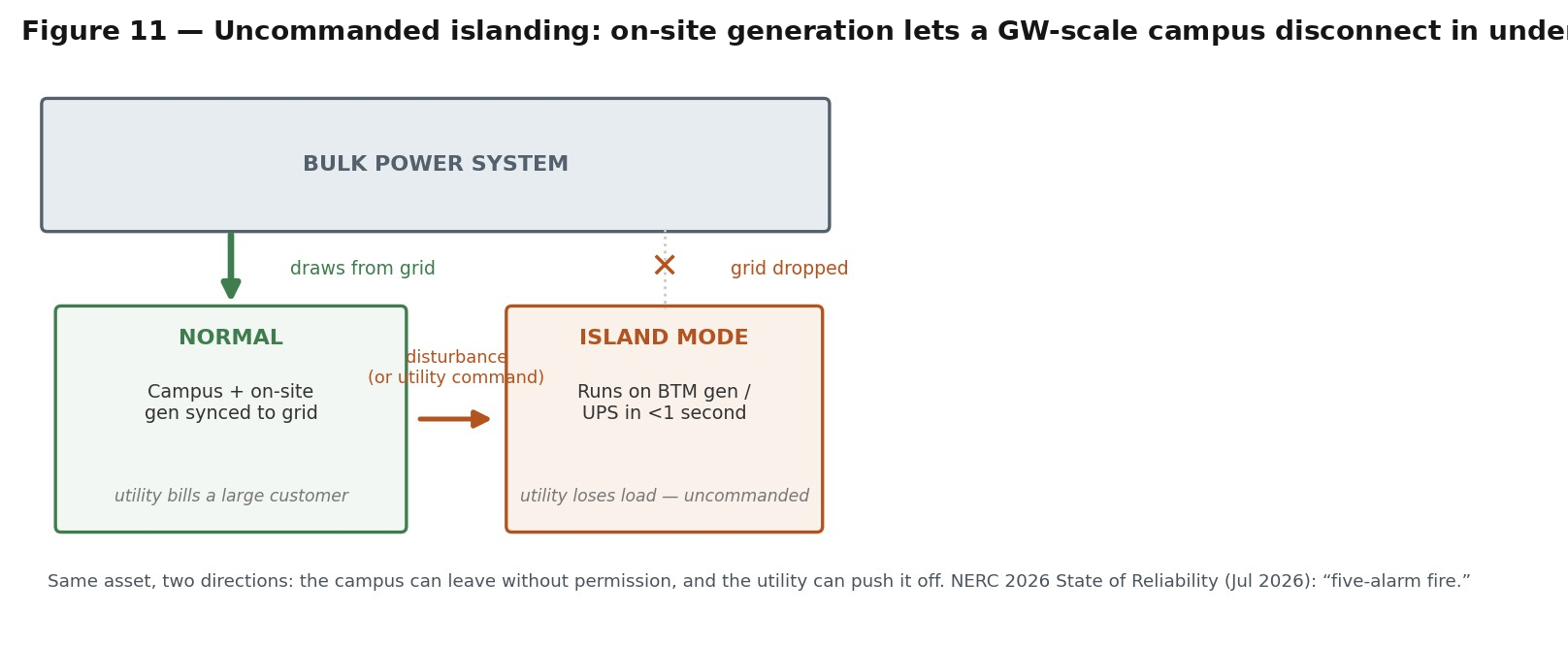
Figure 11 — The same on-site generation works in both directions. It lets the campus disconnect without operator coordination, and it gives a utility the physical basis to disconnect the campus. Either way the grid sees an instantaneous swing.
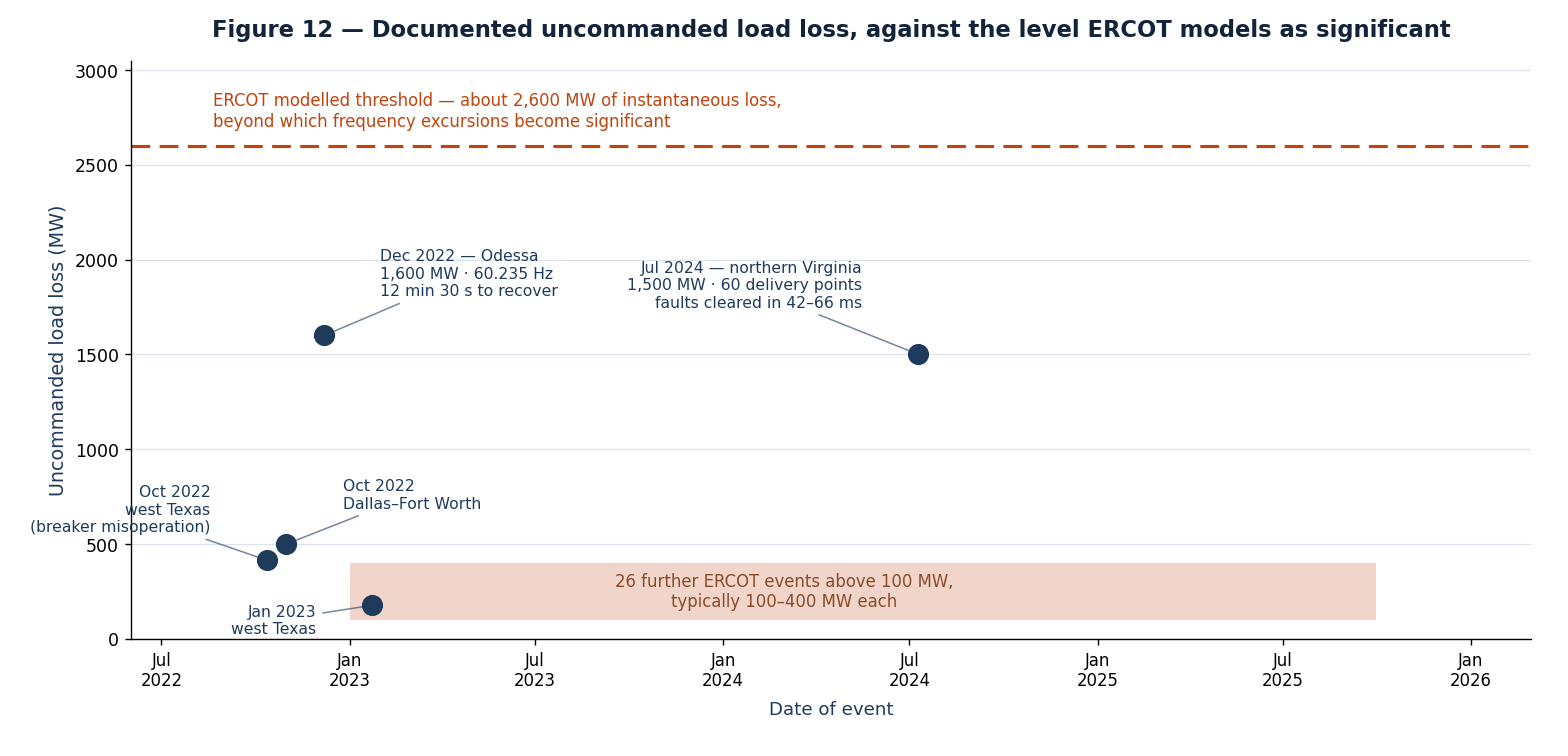
Figure 12 — Documented uncommanded load loss, against the level ERCOT models as significant. Events from the ERCOT PDCWG tabulation and NERC’s incident review; the shaded band covers the 26 further ERCOT events above 100 MW recorded between January 2023 and September 2025. None of these qualify as outages in the conventional sense — no equipment failed and no storm struck; protection circuits sensed a disturbance and the loads left of their own accord. The dashed line marks about 2,600 MW of instantaneous loss beyond which ERCOT’s 2030/31 study case shows frequency excursions becoming significant. Two events have already reached within a thousand megawatts of it.
Problem 2 — The stranded-cost and cross-subsidy trap#
The problem here is financial rather than physical: an islandable campus can leave the utility holding infrastructure built on its behalf, with the unrecovered cost falling on everyone else. Full separation from the grid is rare in practice. Most “off-grid” campuses in fact want a grid tie — for backup when the on-site fleet is down, for startup before it is running, and for the option to sell surplus — so the utility must still build and maintain interconnection and network capacity sized for a customer that may draw almost nothing most of the year. Two kinds of not-drawing create the exposure. A campus may never materialize at the size it reserved, leaving capacity contracted against load that never arrives; or it may materialize and then island during the exact peak hours when its capacity contribution was being counted, so that the utility has planned generation and wires against a load that vanishes precisely when the system needs it most.
The exposure is not hypothetical. AEP’s subsidiaries in Indiana, West Virginia and Kentucky offer the cautionary case already on the books: they acquired roughly 750 MW of generating capacity for data centers that did not materialize and were, as of late 2025, seeking to sell it back into the PJM market. Whether the load never arrives or arrives and then departs, the cost of the stranded capacity does not disappear — it is recovered from the customers who remain, who receive no service in exchange. That is the same cross-subsidy examined in Section 3, arriving through a different door: there it enters through cost allocation in the interconnection study; here it enters through the capacity a no-show or departing customer leaves behind.
Problem 3 — Air, siting, and the reliability of the “backup” itself#
On-site generation does not exit regulation so much as swap one regime for another. Moving the load off the grid moves the project out of the electricity-regulation world and into the air-permitting world, where large reciprocating-engine and turbine fleets face Clean Air Act permitting, local emissions limits, and community opposition that can delay or block a campus more effectively than any interconnection study. That opposition carries real weight: by one tally it blocked or stalled at least 48 data-center projects representing roughly $156 billion of investment in 2025 (Section 7), which makes siting consent a higher-probability failure than the connection study for many projects — and it bears hardest on the gas-burning off-grid campuses this section describes. The reliability of the “backup” is the second half of the problem. A fleet of dozens of engines islanding a gigawatt of critical load has its own contingency profile, and NERC’s guidance now treats behind-the-meter resources as something planners must model explicitly rather than ignore — which cuts against the assumption that on-site generation is a self-contained solution the grid can forget about. The supply-chain constraint from Section 2 compounds all of it: on-site turbines draw on the same sold-out order book as the grid’s, so equipment scarcity, air permitting, and community opposition gate the off-grid route at once.
A distinction runs underneath these siting fights, because two accounting systems that bear on them are routinely confused. A renewable energy certificate records that one megawatt-hour of renewable generation occurred somewhere on the grid at some point in a compliance year. Retiring certificates against annual consumption supports a claim of fully renewable operation, and that claim is accurate as an accounting statement. It describes nothing about the electricity flowing into the facility in any particular hour, and nothing at all about the emissions produced on the site itself.
Air permits operate on the other basis entirely. A permit governs actual stack emissions from identified units, with limits expressed in tons per year and, commonly, in permitted run hours. No certificate offsets a permit condition, and no procurement contract changes what a reciprocating engine emits at the fence line while it runs. Local air quality is a local, hourly phenomenon; certificate matching is a national, annual one. The result is a facility that can be entirely accurate in describing itself as renewably powered while also being the reason a bank of engines runs during the hours a county measures ozone.
The same gap appears on the grid side. Certificates do not alter dispatch: the units that run in the hour the load draws are set by the operator against the system’s constraints, so a campus procuring renewable certificates in one region may still be served by a gas unit in its own. The response developing in the market is hourly rather than annual matching — time-stamped certificates, and carbon-free energy measured hour by hour against the load it actually served — which brings the accounting into contact with the physics. Regulators are separating the two questions for the same reason. A clean-energy claim is not a defence in an air-permit proceeding and does not qualify a siting objection, and this report treats them as independent constraints throughout.
Proposed solutions#
- Registration regardless of grid draw. The cleanest answer: if a facility can affect bulk-system frequency or voltage, its ride-through and modeling obligations should attach whether it imports 1 GW or islands 1 GW. NERC's computational-load registration criteria (draft out for comment through May 15, 2026) are the vehicle, and they are the reason off-grid operation does not remove a facility from the scope of Section 4. FERC's July 16, 2026 order in RD26-7-000 directs NERC to put those criteria into its Rules of Procedure by December 31, 2026, which closes that gap on a date certain rather than on a stakeholder timetable.
- Islanding as a coordinated, not autonomous, action. NERC's May 2026 Reliability Guideline calls for interpersonal communication capability between large loads and their operators and for large loads to be subject to Operating Instructions. Applied to islandable campuses, this converts an uncommanded exit into a scheduled, visible transition the operator can plan around.
- Standby and exit-fee tariff design. Standby rates and minimum-take terms (Section 3 and Section 7) that make a grid-tied-but-islanding customer pay for the capacity held in reserve on its behalf, so the option to leave is priced rather than free.
- Behind-the-meter resources modeled explicitly. The Reliability Guideline's call for resource-adequacy models that represent firm versus flexible load and behind-the-meter generation — so that the plan carries an islandable gigawatt as the swing resource it represents rather than as a firm subtraction from demand.
- The regulatory backstop. On-site generation also gives a utility the legal basis to require a campus to island during emergencies — converting the islanding capability into a demand-response asset if the terms are written that way. ERCOT's WLPUN constraint (Section 5) offers an early version: unresolved imbalance within one minute lets ERCOT limit or suspend the arrangement.