Context and synthesis
Synthesis: The Eight Issues as One Planning Problem#
Read separately, the eight issues look like eight problems for eight committees. Read together, they present a single problem in eight forms. Every section of this report traces back to a single fact: a new class of load — large, fast, concentrated, mobile, and self-protecting — has arrived on a grid built for demand that was small, slow, diffuse, captive, and passive. Each issue marks where one of those properties collides with one of those assumptions, and the remedies stop looking fragmented once they are mapped back to the property each is actually answering.
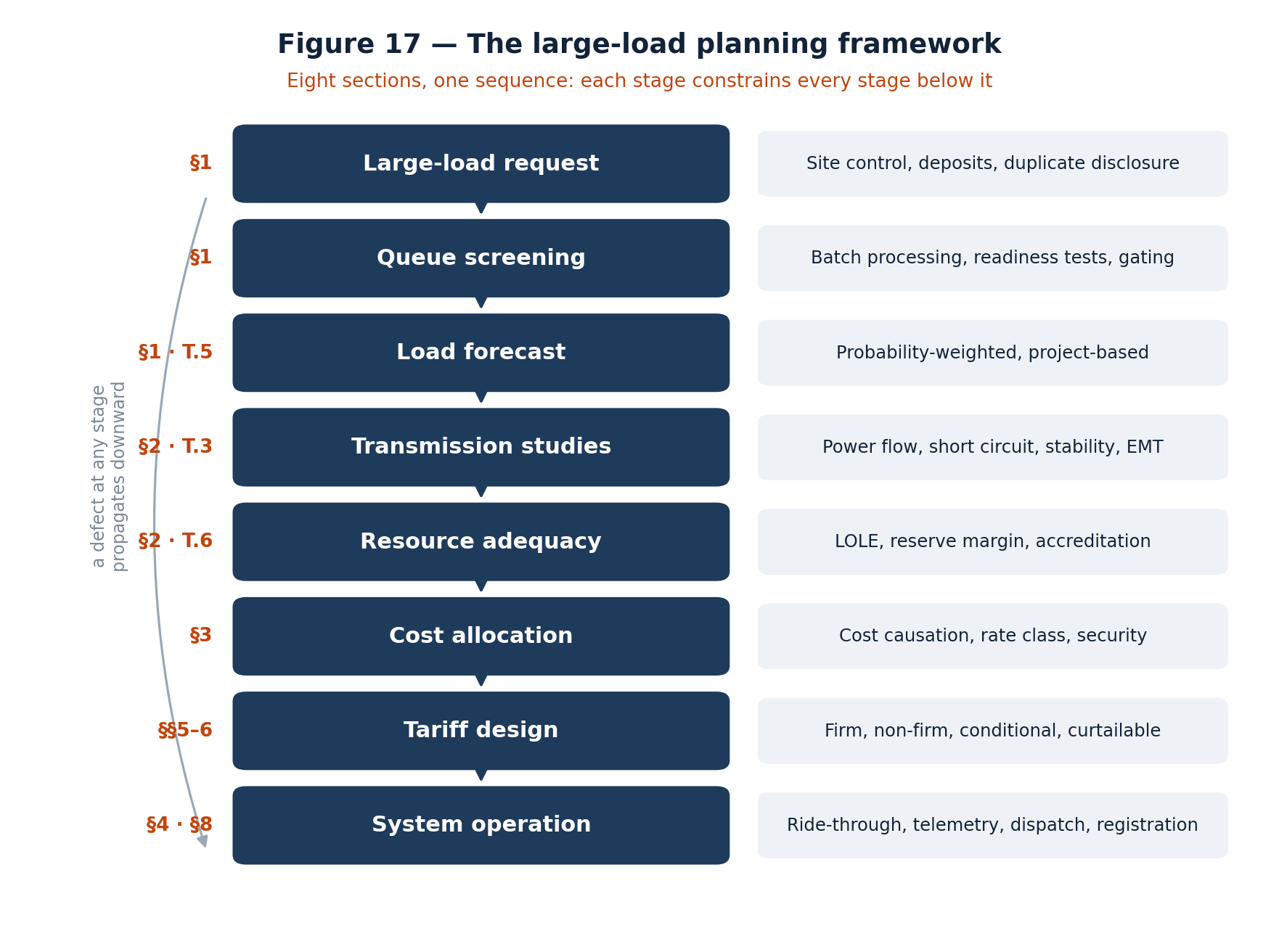
Figure 17 — The large-load planning framework. One or more sections of this report treat each stage, and each constrains every stage below it: a queue that records optionality rather than demand corrupts the forecast, which corrupts the studies, which corrupt the adequacy assessment and the cost allocation built on it. The figure states the report’s organising claim: the eight issues mark stages of one planning process rather than eight independent problems.
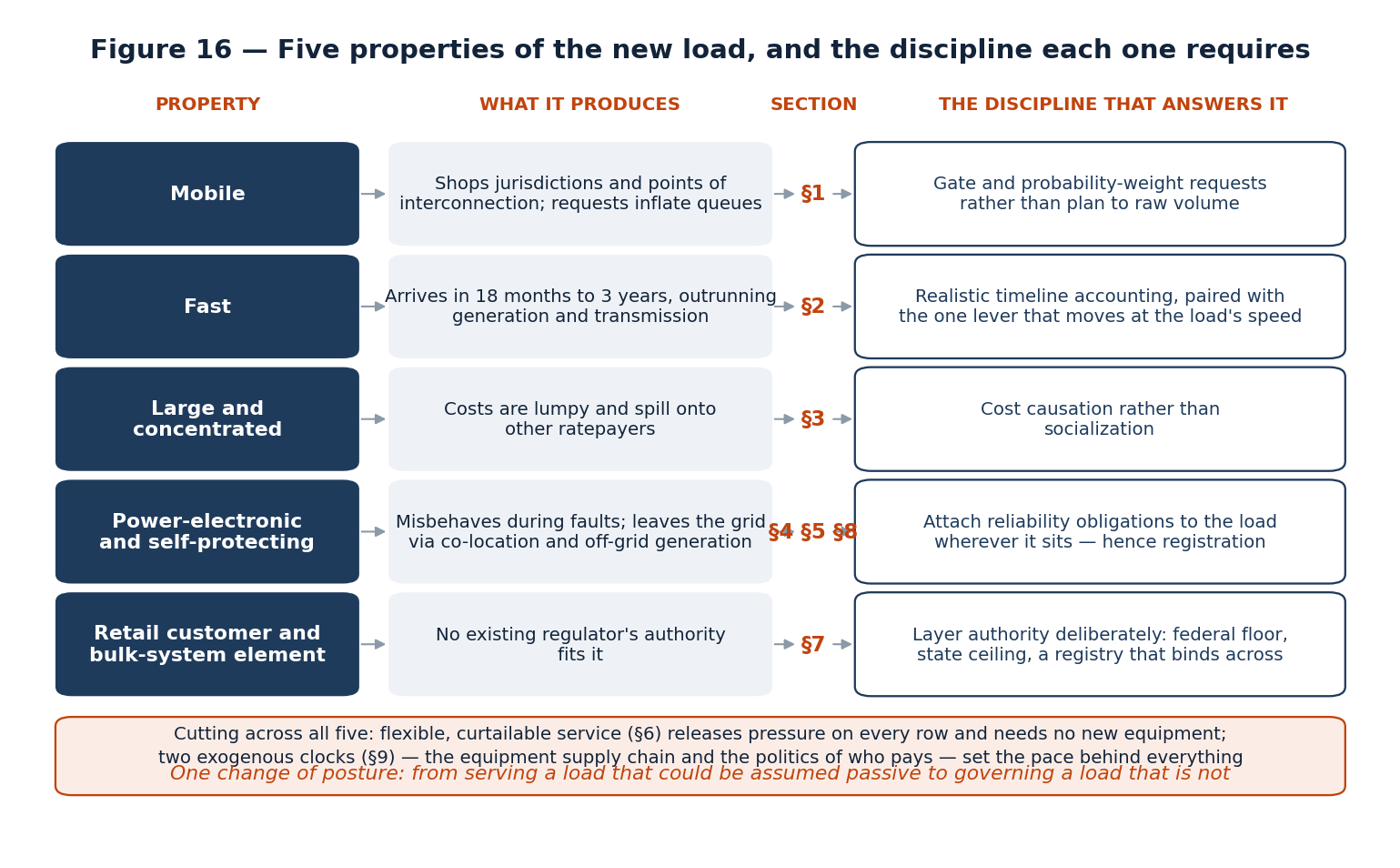
Figure 16 — Five properties of the new load, and the discipline each one requires. Each row reads left to right: a defining property of computational load, what that property produces, the section that treats it, and the discipline that answers it. The banner beneath covers the two elements that cut across every row — flexible service, which releases pressure everywhere and needs no new equipment, and the two exogenous clocks that set the pace behind all of it.
The framework reads across five rows. Because the load moves, it shops jurisdictions and points of interconnection, which inflates the queue (§1) and invites regulatory arbitrage (§7); the discipline gates and probability-weights requests rather than planning to raw volume. Because it arrives fast, it outruns generation and transmission (§2); the discipline pairs realistic timeline accounting with the one lever moving at the load's own speed. Its size and geographic concentration make its costs lumpy and spill them onto other ratepayers (§3); cost-causation rather than socialization supplies the discipline. Power electronics and self-protection make it misbehave during faults (§4) and tries to leave the grid altogether through co-location (§5) and off-grid generation (§8); the discipline that reaches all three attaches reliability obligations to the load wherever it sits — which is why NERC registration, rather than any tariff, carries much of the weight. And because the load acts at once as a retail customer and as a bulk-system element, no existing regulator's authority fits it (§7); the discipline layers authority deliberately — a federal reliability floor, state retail ceiling, and a NERC registry that binds across the line.
Two things sit outside the rows because they cut across all of them. Flexible, curtailable service (§6) releases pressure across the entire system: it alone moves fast enough to match the load, and it alone needs no new equipment, which is why it recurs as a leading answer to the timeline, cost, and adequacy problems at once. And two exogenous clocks (§9) set the pace behind everything — the equipment supply chain and the politics of who pays — neither of which a grid engineer can fix, both of which intensify the speculation at the root.
The eight sections separate for exposition and not in operation, and four connections carry most of the weight. The first runs from queue integrity to everything downstream. Capacity prices, transmission plans and reserve margins all compute against forecast load, so a queue that records optionality rather than demand corrupts each of them simultaneously. Sections 2 and 3 cannot be solved while Section 1 remains unsolved. The gating measures now in force — financial security, duplicate-request disclosure, probability weighting — precede the cost-allocation debate rather than running beside it.
The second connects speed to firmness. A developer unable to obtain firm service on an acceptable timetable does not wait; it buys a different product. That impulse produces co-location (Section 5), off-grid generation (Section 8) and curtailable service (Section 6) as three responses to one constraint, and it explains why they are converging on similar terms. Each trades some claim on the system for an earlier energisation date. The distinction that matters turns on whether the operator can see the trade: a curtailment contract shows, and an islanding campus does not.
The third runs between physical behaviour and legal status. A load that disconnects during a fault (Section 4), or that leans on the grid when its host generator trips (Section 5), is a bulk-system element behaving as one — but obligations attach to registered entities, not to physical significance. This is why the December 31, 2026 registration filing recurs throughout the report as a precondition rather than a formality. Until an operator can identify the facility, it can neither bind it to a standard nor investigate what it did.
The fourth runs jurisdictional, and it constrains the other three. Every remedy above sits on one side of the line §201(b) draws — interconnection and transmission service on the federal side, retail terms and cost allocation on the state side — while the problem sits across it (Section 7). No participant holds both the decision and its consequence, so each remedy has to be assembled from instruments held by different authorities. That supplies the structural reason this report describes eight problems and no single fix: not because the engineering lacks clarity, but because the statute divides the authority to act on it by design.