Section 7 of 8
7. Jurisdiction and the Non-RTO Grid: Who Actually Writes the Rules#
The issue. The first six sections assume someone holds authority to impose the fix; that assumption remains contested. Section 201(b) of the Federal Power Act gives FERC jurisdiction over interstate transmission and wholesale sales, and expressly reserves to the states authority over retail sales, local distribution, generation, and siting. A data center serves as a retail customer and, physically, as a transmission-connected element whose behavior determines whether the bulk system holds together. Ninety years of settled doctrine did not anticipate a retail customer doubling as a bulk-power-system contingency. DOE's October 2025 §403 directive pushed hard on this line, asking FERC to standardize interconnection for loads above 20 MW connecting to the transmission system. NARUC responded bluntly: FERC asserting jurisdiction over load interconnection sits outside the boundaries of the FPA, and because states set rates across customer classes, a federal service offering aimed at a narrow class of retail customers would displace a balancing act that is solely a state decision. The National Conference of State Legislatures added the practical version of the question: if FERC takes the interconnection decision, who then holds the reliability and supply consequences?
FERC had already shown its hand on this, and the case is worth setting out because the distinction it turns on recurs throughout this section. In October 2025 the Commission rejected Tri-State Generation and Transmission’s proposed High Impact Load tariff, three votes to nil, in Docket ER25-3316. The rejection did not rest on the merits. Tri-State faced roughly 7 GW of data-center interest across its forty-odd member distribution cooperatives in Colorado, Nebraska, New Mexico and Wyoming, and a genuine cost-shifting problem that the tariff was a reasonable attempt to solve. What defeated it was the vehicle. Tri-State operates as a wholesale generation and transmission cooperative, selling power to its member cooperatives at rates that fall under FERC jurisdiction — which explains why the filing went to FERC at all. The High Impact Load tariff did not stop at the wholesale relationship. It specified the terms on which a member cooperative’s own end-use customer would be served — minimum demand obligations, contract duration, collateral and exit charges applying to the data center itself. Those are terms and conditions of retail sale, which §201(b) reserves to the states without qualification. A federal tariff cannot reach through a wholesale contract to set them, however sound the policy behind it, and the Commission has said explicitly, citing Supreme Court precedent, that it may not reach retail sales no matter how direct or dramatic the effect on wholesale rates.
The states hold substantive powers in that lane, not formal ones, which explains how firmly they defend the boundary. A state commission determines which customer classes exist and how costs are allocated among them, so creating a large-load class is an act of redistribution among residential, commercial and industrial ratepayers that only the state may perform. It determines which utility is obliged to serve a customer in a given territory and on what conditions that obligation may be qualified. It determines whether a minimum-take provision, a twelve-year term or an exit fee is just and reasonable as applied to a retail customer, and it approves the resulting rate. And it holds the consequence: if a large load defaults or never materialises, the stranded cost falls on the distribution utility’s remaining retail customers, whose rates that same commission sets. NARUC’s objection is this in one sentence — a federal service offering aimed at a narrow class of retail customers would displace a balancing act that is solely a state decision — and the NCSL’s question follows from it: a federal body that takes the interconnection decision does not thereby acquire the obligation to serve, or the ratepayers who absorb the failure.
The June 18, 2026 orders read best as FERC accepting that constraint rather than testing it. The Commission did not federalize large retail load interconnection. It claimed the transmission lane: service to Eligible Customers, the study processes that determine whether the system can supply that service reliably, network upgrade costs flowing into jurisdictional rates, generator interconnection procedures, and ancillary-service charges for load that still leans on the grid. Against that, it repeatedly preserved state authority over the specific terms of retail sales to large loads, over which entities may serve them, and over siting and construction. That baseline reaches transmission only, which likely explains why FERC chose six regional show-cause orders over a generic national rule: an order construing a particular RTO's tariff is far more durable on review than a rulemaking that has to define the jurisdictional boundary in the abstract.
The December 2025 co-location order had already drawn the same line, and more explicitly. Having found core portions of PJM’s tariff unjust and unreasonable, and having directed three new transmission services in their place, the Commission declined to address the jurisdictional question underneath: whether the interconnection of a retail load served through a co-location arrangement falls to it at all. The position of that reservation matters as much as its content. FERC reached the rates, the terms, the study obligations and the capacity accounting, then stopped at the one question that would have settled which regulator governs the arrangement as a whole. A reader should take the June 18 orders as the same choice repeated across six regions rather than as a new position. On the evidence of both, the jurisdictional boundary will move through litigation or through Congress, and not through the Commission volunteering to redraw it.
Who decides what#
The federal-state line generates the litigation, but other boundaries matter just as much, and an actor holding no authority over electricity can stop a project outright. The table below names each participant, the source of its authority, what it decides, and — the column that usually explains the deadlock — what it cannot reach.
| Actor | Authority derives from | Decides | Cannot reach |
|---|---|---|---|
| FERC | Federal Power Act §§201–206, 215; Natural Gas Act | Interstate transmission service and its rates; wholesale sales; RTO and ISO tariffs; generator interconnection procedures; network-upgrade cost allocation; ancillary-service charges; approval of NERC standards. | Retail sales and their terms; local distribution; generation and transmission siting; which entity is obliged to serve a customer. |
| NERC and the Regional Entities | FPA §215; certification by FERC, with authority delegated to six regional entities including Texas RE and WECC | Mandatory reliability standards, and which entities are registered to be bound by them. Registration criteria for computational load are due December 31, 2026. | Anything concerning rates. Any entity it has not registered — which is why registration precedes every reliability obligation in Section 4. |
| RTOs and ISOs (PJM, MISO, SPP, CAISO, NYISO, ISO-NE) | A FERC-accepted tariff and a stakeholder governance process; not a delegation of governmental power | System operation and dispatch; interconnection study queues and their sequencing; market design and capacity accreditation; planning cases and reliability criteria. | Nothing takes effect until FERC accepts it. No authority over retail rates, over customer classes, or over whether a facility may be built. |
| ERCOT and the PUCT | Texas law; ERCOT is exempt from FERC transmission jurisdiction under FPA §201(b)(1) because it is not synchronously interconnected across state lines | Protocols (NPRR, NOGRR, PGRR), interconnection process, market design, and retail rules — all within one state, which is why reforms move faster here than anywhere else. | NERC reliability standards still apply through Texas RE. Federal reliability obligations are not escaped by the jurisdictional exemption. |
| State public utility commissions | State statute, operating in the space §201(b) reserves | Retail rates and tariff terms; which customer classes exist and how costs are allocated among them; the obligation to serve and certificates of convenience and necessity; integrated resource plans; utility capital approvals; transmission siting in most states. | Wholesale rates; interstate transmission service; the contents of an RTO tariff. A state may not bind a neighbouring state whose grid it shares. |
| State legislatures | Plenary state authority | Statutory mandates for large-load tariffs, moratoria, tax abatement, siting law, and the scope of commission authority itself. | The federal lane, though state law shapes what a utility may offer within it. |
| Municipalities and counties | Local land-use and police powers, delegated by the state | Zoning, land use and building permits; water and wastewater service; local noise, air and lighting conditions; property-tax abatement; and, increasingly, moratoria on data-center development. | Rates, grid operation and reliability standards. Local authority cannot make a project connect — but it can prevent one from being built at all. |
| Municipal utilities and electric cooperatives | Municipal charter or member governance; largely exempt from FERC rate jurisdiction under FPA §201(f), and in many states from commission rate regulation | Their own retail terms, including large-load tariffs, set by city council or member board rather than by a commission. | Not exempt from reliability standards where they operate bulk-power facilities. Tri-State’s rejected filing shows the limit of routing retail terms through a wholesale tariff. |
| US Department of Energy | FPA §202(c); §403 directives; national-interest corridor designation | Emergency orders that override economic dispatch and may keep units running; corridor designations that unlock federal siting backstop; directives asking FERC to act. | Ordinary ratemaking and interconnection. A §403 directive asks; it does not decide. |
| EPA and state environmental agencies | Clean Air Act and state analogues | Air permits for on-site and backup generation, including permitted run hours — often the binding constraint on behind-the-meter generation (Section 5). | Anything about electrical service or grid operation. |
| Federal courts | Judicial review of final agency action, principally in the courts of appeals | Whether a FERC order survives challenge — which is why the Commission preferred six region-specific show-cause orders to a generic rule that would have to define the jurisdictional boundary in the abstract. | They review; they do not design. |
Table 7A — Authority over large-load integration. Read the final column first: almost every unresolved question in this report sits where one actor’s competence ends and no other actor’s begins.
Sources: Federal Power Act §§201–206 and 215; state enabling statutes; FERC orders as listed in the Catalog.
Three consequences follow from the shape of that table. The first is that no actor holds both the decision and its consequence. FERC and the RTOs determine whether a load may connect and on what transmission terms; the state commission and the distribution utility carry the cost if the load never arrives or fails to pay. A structure that separates the two invites each side to discount what it does not bear.
The second is that several actors hold a veto and none holds an initiative. A county can refuse a zoning permit, a state commission can refuse a tariff, FERC can reject a filing, and an air permit can cap the run hours that make on-site generation viable — but no participant in the table can direct that a facility be built, connected and served on a defined timetable. That asymmetry is why the reforms in Sections 1 to 6 take the form of process changes and price signals rather than directives.
The third concerns the two entries that sit outside the ordinary structure. Cooperatives and municipal utilities escape FERC rate jurisdiction under §201(f) and, in many states, commission rate regulation as well, leaving their large-load terms to a member board or a city council rather than to any regulator — a significant fact given how much of the load is landing in their territories. ERCOT sits outside federal transmission jurisdiction altogether, which is the reason it produces the earliest and most complete reforms in this report and the reason those reforms bind nobody else. Both are reminders that the map is not a hierarchy. It is a set of overlapping competences, most of which were settled before a single customer could constitute a system contingency.
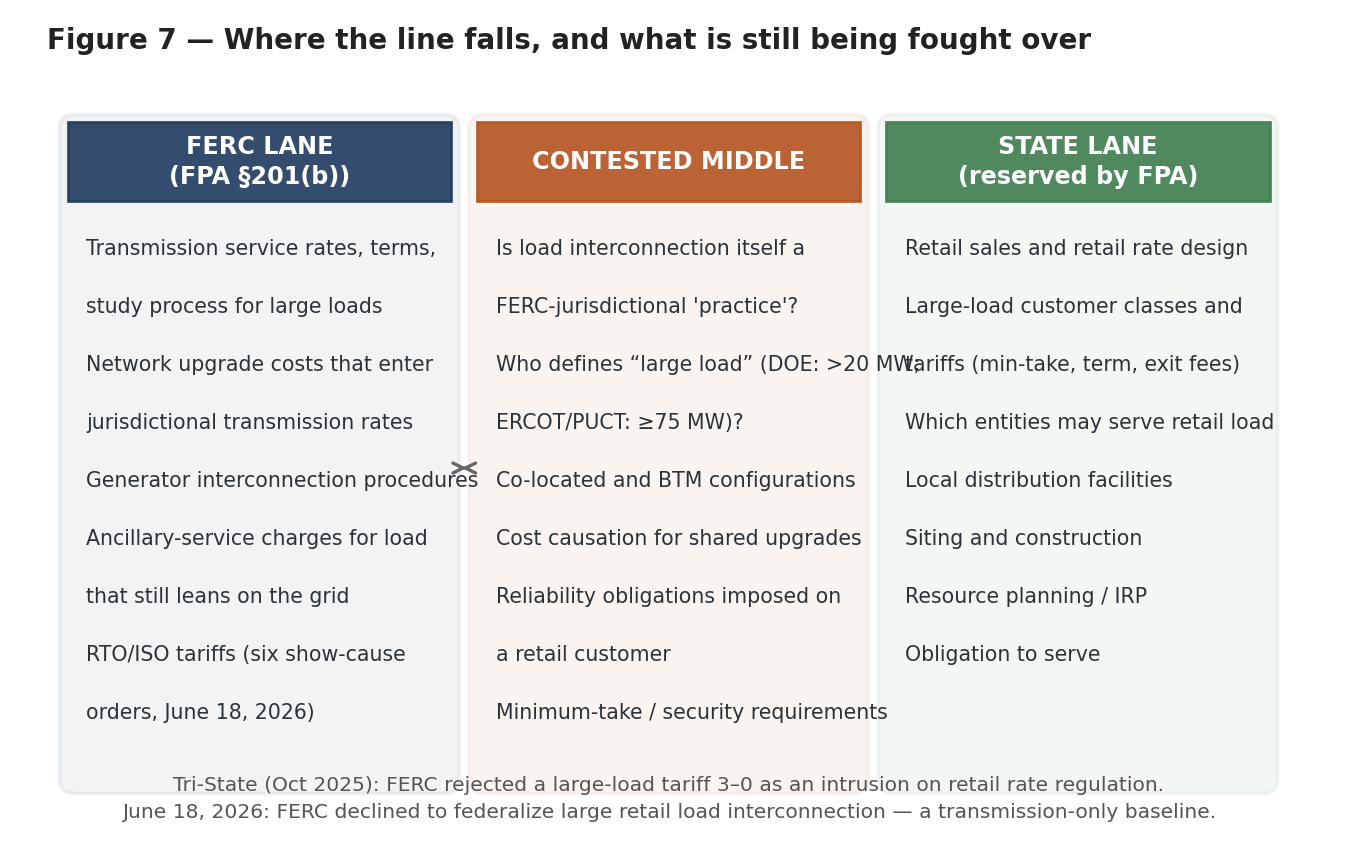
Figure 7 — The Federal Power Act’s division of authority, showing the matters clearly federal, those clearly reserved to the states, and the contested band between them. The middle column matters because it contains the instruments large-load policy actually requires — service terms, cost allocation, and the conditions attached to interconnection — none of which sit wholly on either side. Readers should conclude that the difficulty is structural rather than political: no participant holds both the decision and its consequence, which is why remedies must be assembled from instruments held by different authorities (Table 7A).
The consequence: a patchwork, and the utilities nobody is orchestrating#
Because the retail lane belongs to the states, fifty commissions now write the substantive commercial rules for large loads fifty times over, on fifty schedules. EEI counted twenty-three states with at least one approved large-load tariff as of May 2026 and another seven pending; SEPA counted at least 65 tariffs pending or in place across 34 states at the end of 2025, forty-six of them new that year. The terms show no sign of converging. AEP Ohio's PUCO-approved tariff covers loads at or above 25 MW. It requires payment for at least 85% of contracted capacity regardless of consumption, imposes a twelve-year minimum term and exit fees, and can add on the order of $10 million in first-year cost for a 100 MW facility. Enverus estimates that it cut connection requests roughly in half. That either shows the tariff filtering speculation or shows it exporting the load to another state, depending on who describes it. Dominion's GS-5 class in Virginia sits at the same strict end. Georgia Power's PLL-18 framework offers notably more flexible terms, and Georgia Power had 28 large-load projects representing about 11 GW under contract as of Q1 2026. Pennsylvania's 2026 model tariff took a third path, adopting a “butfor” cost-causation standard directly.
One layer of this system is missing from the account above, because it is not a government. Trade associations intervene across all of these venues at once — the Data Center Coalition for the owners and operators, the Edison Electric Institute for the utilities, the supply-side and consumer advocates alongside them — and they are the only participants who appear in every docket, in fifty state proceedings and at NERC simultaneously. That is worth naming precisely because §3 already credits customer-side pressure with harmonising the tariffs faster than any regulator will: if that is true, the mechanism doing the harmonising is this one, and it is accountable to its members rather than to a commission. Equipment vendors sit outside it — they are not eligible for Coalition membership, which is open to data-center owners, operators and large end users — yet the capability claims that shape what a standard can demand originate with them. Membership criteria primary; the characterisation of the associations' role is this report's own.
The clearest instance of that arrived in March 2026. The Flex MOSAIC framework was released with an open letter of support signed by more than thirty organisations and now carrying more than fifty, among them NERC, MISO and SPP alongside Exelon, Rayburn Electric Cooperative, Google, Meta, NVIDIA and Siemens. A reliability authority and two RTOs endorsing a classification authored by a research consortium whose members include the regulated parties is private ordering ahead of public rulemaking, and it is not obviously wrong — the taxonomy is technical, the expertise sits with the participants, and NERC standards already work this way through the drafting teams. The question §7 should put is narrower: an open letter is not a tariff and not a standard, so if Flex MOSAIC ends up written into connection studies it will have acquired binding effect without ever passing through a proceeding in which a ratepayer advocate had standing. Signatory counts primary; the characterisation is this report's own.
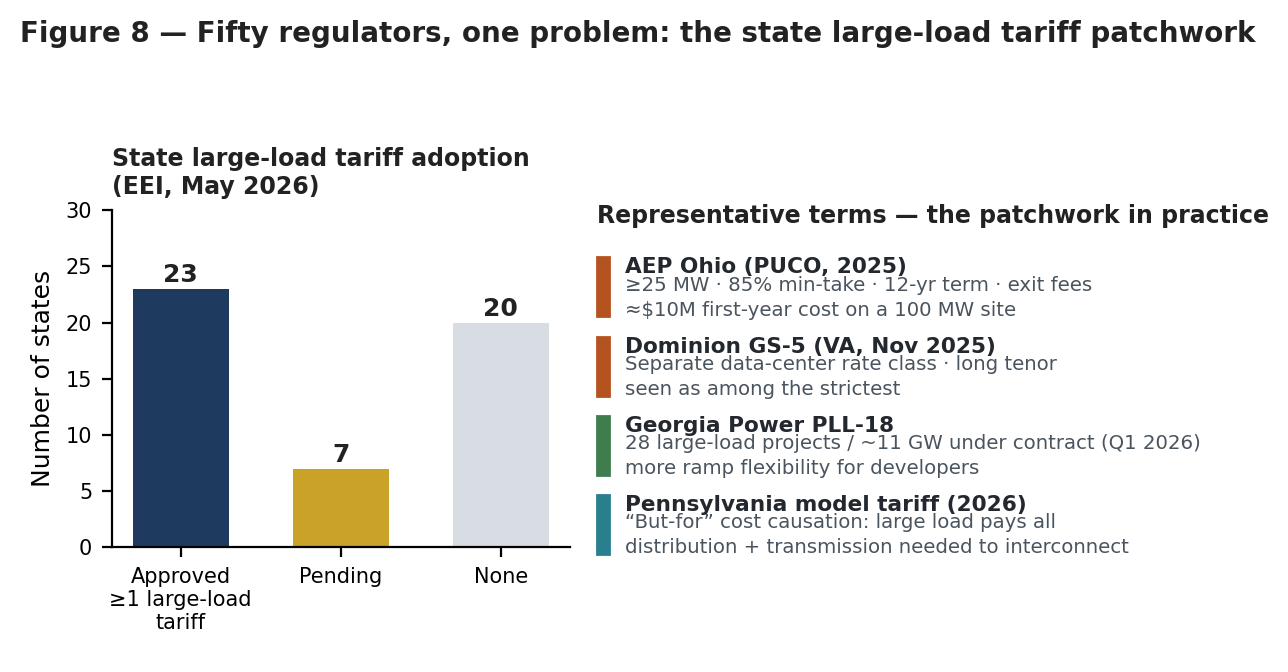
Figure 8 — State adoption of large-load tariffs, and the variation in their terms. Adoption is now widespread, but minimum-take levels, contract durations, exit fees and collateral requirements differ substantially between jurisdictions. The variation matters because these are retail terms reserved to the states (Section 7), so no federal action will harmonise them. For a developer, jurisdiction selection has consequently become a larger financial variable than most engineering decisions.
The second consequence is geographic. Sections 1 through 6 tell an RTO story, and a large share of American data-center load never lands in an RTO. The Southeast, most of the West outside CAISO, and the co-op and municipal systems have no ISO tariff to reform, no stakeholder process to run, and no show-cause order to answer. FERC's Chairman used the June 18 meeting to encourage transmission providers outside RTO/ISO regions to bring comparable reforms voluntarily under FPA §205, and the Commission expressly declined to foreclose future action reaching non-RTO regions. Encouragement carries no deadline. In the meantime the vertically integrated utility does the interconnection study, sets the tariff, plans the resources, and answers to a single state commission — which is faster and more coherent than the RTO process, and also almost entirely opaque to anyone outside it.
The jurisdictional patchwork runs inside the RTO footprint as well as outside it. CAISO does not offer traditional Order No. 888 transmission service, so FERC had to apply a different analytical framework to reach it — and still found substantially similar deficiencies. NYISO’s order turns on cost shifting through the Transmission Service Charge when speculative service requests drive local transmission planning, which is Section 3’s problem arriving through a New York-specific mechanism. The same failure mode surfaces through six different tariff structures, and no single remedy fits all six.
A third consequence concerns the utilities that no commission regulates at all. Municipal utilities and electric cooperatives are exempt from FERC rate jurisdiction under §201(f), and in many states from public utility commission rate regulation as well. Their large-load terms are therefore set by a city council or an elected member board, in a process with no formal record, no intervenor rights and no expert staff review. This is not a marginal category. Cooperatives serve much of the low-cost rural land where campuses are now siting, and municipal systems serve several of the metropolitan areas competing hardest for them.
The consequences run in both directions. A board answerable directly to the members who are also the ratepayers can weigh a cross-subsidy question with an immediacy no commission docket achieves, and municipal utilities have been among the fastest movers on flexible service — the demonstration underlying Google’s demand-response contracts was run with Omaha Public Power District. But the same structure means a minimum-take provision or an exit fee can be agreed without the contested proceeding that would test it elsewhere, and a member co-op has neither the staff nor the leverage of a state commission when negotiating with a counterparty of this size. Tri-State’s attempt to solve the problem once at wholesale, and its rejection, left forty-odd distribution cooperatives to answer the same question separately.
Counties and municipalities hold a further power, and it is the bluntest in the report. Land use, zoning, building permits, water and wastewater service, and local noise and air conditions are all local decisions, and a growing number of jurisdictions have imposed moratoria on data-center development outright. No energy regulator can override them. A project may hold a queue position, a signed tariff and an approved interconnection agreement and still not be built, which means the reforms in Sections 1 through 6 govern only the projects that clear a gate none of those sections describes.
How the non-RTO grid works, and where it differs#
About two-thirds of U.S. electricity load sits inside an RTO or ISO; the remaining third is served by vertically integrated utilities that own their transmission, plan it themselves, and answer to a state commission rather than to a market. Outside the organized markets no independent operator runs an auction or a single regional queue. The transmission provider is usually the local utility itself, and it decides what to build through an Integrated Resource Plan — a multi-year forecast of load and resources filed with, and approved by, the state commission — rather than through an RTO process. For a large load, that changes who sits on the other side of the table and which document governs the connection.
| Dimension | RTO / ISO | Non-RTO transmission provider |
|---|---|---|
| Grid operation | Independent regional operator dispatches the system | Utility runs its own balancing authority, or joins an Energy Imbalance Market |
| Transmission planning | Centralized, region-wide planning | Utility-led planning through an Integrated Resource Plan, with regional coordination |
| Serving a large load | Interconnection under the RTO tariff and a common study queue | Bilateral service under the utility’s Open Access Transmission Tariff (OATT) and state process |
| Building transmission | Independent, sometimes competitive, expansion process | Utility proposes and builds, subject to state regulatory approval |
| Wholesale supply | Competitive energy and capacity markets | Bilateral contracts; increasingly, day-ahead markets (SPP Markets+, CAISO EDAM) |
| Cost allocation | Regional market rules and FERC-approved formulas | Utility transmission tariff and state ratemaking |
| Who writes the rules | FERC on transmission; RTO stakeholder process | State commission on retail terms; utility under FERC Order 890 and NERC standards |
Table 7B — How large-load service differs outside the organized markets. The contrast is becoming less absolute as non-RTO utilities join energy-imbalance and day-ahead markets, but transmission planning and ownership remain with the utility.
The providers are among the largest utilities in the country. The Southeast has no RTO at all: service there runs through Duke Energy, Southern Company’s operating utilities, the Tennessee Valley Authority, Dominion’s Carolina system, and Florida Power & Light. Most of the West outside California is served by the Bonneville and Western Area Power Administrations, NV Energy, Arizona Public Service, Salt River Project, PacifiCorp, and Idaho Power. In place of an RTO planning process, these utilities coordinate through regional reliability and planning bodies — SERTP in the Southeast; NorthernGrid, WestConnect, and the Northern Tier Transmission Group in the West; and WECC’s committees across the interconnection — which coordinate reliability and expansion without operating a market.
| Region | Major transmission providers | Regional planning coordination |
|---|---|---|
| Southeast (no RTO) | Duke Energy; Southern Company (Georgia, Alabama, Mississippi Power); Dominion (Carolinas); Florida Power & Light; Tennessee Valley Authority; Santee Cooper | SERTP |
| West, outside CAISO | Bonneville Power Administration; Western Area Power Administration; NV Energy; Arizona Public Service; Salt River Project; PacifiCorp; Idaho Power; Public Service Co. of New Mexico | NorthernGrid; WestConnect; Northern Tier Transmission Group; WECC (TEPPC); CREPC |
| Alaska & Hawaii (islanded) | Chugach Electric and Golden Valley Electric (AK); Hawaiian Electric (HI) | Standalone systems; no interstate market |
Table 7C — The major transmission providers outside the organized markets, and the bodies through which they coordinate. Note that “outside ERCOT” is not the same as “outside a market”: much of Texas outside ERCOT, and the non-RTO Midwest, is served by other RTOs (SPP, MISO) rather than by non-RTO utilities.
Sources: FERC and EIA ISO/RTO service territories; utility and regional-planning-body membership. The share of national load inside RTO regions (about two-thirds) is a FERC figure; the data-center-specific split is not tracked in any authoritative national dataset.
Three practical differences follow for a large load that lands outside a market. Its interconnection study is run by the transmission provider itself, under FERC Order 890 planning requirements for jurisdictional utilities and the applicable NERC reliability standards, rather than through an independent queue. Its cost allocation and any network upgrades are set by the utility’s transmission tariff and the state ratemaking process, not by regional market rules. And the resource adequacy it relies on is assessed through the utility’s Integrated Resource Plan rather than a capacity market — which is why an estimated one-third of the fast-growing pipeline, concentrated in exactly these territories, sits outside the market mechanisms Sections 1 through 6 describe. The line is blurring: many of these utilities now participate in Energy Imbalance Markets, and several are entering regional day-ahead markets such as SPP Markets+ or CAISO’s Extended Day-Ahead Market. But those are energy-dispatch arrangements; planning, transmission ownership, and the authority to approve a large-load connection stay with the utility and its state commission.
The authority vacuum is being filled by retail politics#
The jurisdictional map holds nothing static: ratepayer politics redraws it in real time, and that determines which of this report's fixes get adopted. Legislators filed more than 300 data-center bills across thirty-plus states in 2026 alone, a decisive shift from courting data centers with tax incentives to constraining them with cost-causation rules. The forms vary: separate large-load rate classes (at least eighteen states), water disclosure and permitting requirements, tax-incentive rollbacks, first-of-their-kind consumption taxes (Virginia's $0.011/kWh, effective July 1, 2026), and, in a growing minority, outright construction moratoriums — New York imposed the first statewide pause in the nation — and it arrived by executive order signed July 14, 2026, not by the legislation this report originally anticipated. The order pauses discretionary state environmental permits for new hyperscale facilities drawing 50 MW or more for up to one year while the Department of Public Service prepares a Generic Environmental Impact Statement and advances the Energize NY proceeding, which would require data centers either to pay more for energy or to self-supply. Maine's governor vetoed one, and dozens of localities have imposed their own. The federal Ratepayer Protection Pledge (March 4, 2026), in which seven hyperscalers voluntarily committed to cover their own generation costs, supplies the unenforceable counterweight, and it has not slowed the state activity. In mid-July 2026 the administration moved to broaden the pledge, convening utilities, developers and the governors of leading states — and it did so in the same week New York's moratorium took effect, which illustrates most sharply that voluntary federal signaling has not arrested the state-level constraining trend. Two implications follow for the rest of the report. First, political economy governs adoption of the fixes in Sections 1 through 6: “but-for” cost assignment, minimum-take tariffs, and exit fees fall to public-utility commissions under political pressure rather than to engineers, and a well-designed tariff loses all value if a moratorium freezes the market it was written for. Second, the air- and water-permitting and local-opposition gate treated as a secondary problem in Section 8 is, in political-economy terms, often the primary one: by one tally, at least 48 datacenter projects representing roughly $156 billion of investment were blocked or stalled by local opposition in 2025, a higher hit rate than the interconnection study imposes. On that evidence, community consent rather than connection capacity increasingly binds where a gigawatt can land.
Proposed solutions#
- Federal floor, state ceiling. The position several state regulators have urged: FERC sets minimum interconnection standards and performance requirements; state commissions retain retail tariff regulation on top of them. On current evidence this structure appears most likely to produce a stable equilibrium, and it mirrors how NERC standards already operate across the jurisdictional line.
- NERC registration as the jurisdictional workaround. Reliability obligations attach to registered entities on the bulk power system, not to retail customers as such. If NERC's computational-load registration criteria land where they appear headed, ride-through and modeling requirements bind a 500 MW campus in Georgia and one in PJM identically — without resolving the FPA question at all. This may be the quietest answer in the report, and among the most consequential.
- Voluntary §205 filings by non-RTO transmission providers. The path FERC invited on June 18. Watch which Southeastern and Western transmission owners take it up; the ones that do would signal an interest in federal cover for terms their state commissions might otherwise contest.
- Multi-state coordination compacts. The thirteen PJM-state governors' joint statement of principles is the working prototype: states acting in concert to allocate costs to data centers and protect residential customers, which achieves harmonization without federal preemption.
- Tariff convergence pressure from the customer side. The Data Center Coalition argued in the Tri-State docket that the utility-by-utility patchwork itself stifles development. That argument serves the Coalition's interest, though the underlying observation appears sound; industry pressure for standard terms may harmonize the tariffs faster than regulatory action would.
- The same convergence pressure has a second face at the federal level. Asked in March 2026 whether it supported or opposed mandatory reliability standards for computational load, the Coalition declined to take a position, saying it was reviewing the Large Load Working Group's recommendations and arguing that any requirement should rest on complete evidence and on the technical capabilities of data-center equipment. Placed beside the chip vendor's contemporaneous claim that the newest platforms already smooth the swings, that is a coherent argument for calibrating the standard to what the hardware can do — and a reason to read equipment capability and standard scope as one question rather than two (§4, §7). Reported; the Coalition has filed no position statement located in the §206 dockets.