Section 5 of 8
5. Co-Location, Behind-the-Meter Generation, and Electrically Proximate Load#
The issue. If the grid cannot serve you, put the plant on your own site. Co-location — siting a large load directly at an existing generator, typically nuclear — offers the fastest route to gigawatt-scale power, and it broke the tariff. Every unresolved question turns on how much the arrangement still leans on the grid: whether the co-located load counts as a transmission customer at all, whether the host generator can still sell capacity, what happens when the load draws during a unit outage, and who pays for the transmission and ancillary services it still uses. The rules now in force trace back to a single rejected contract. PJM filed an amended interconnection service agreement for the Susquehanna nuclear station in June 2024, raising the load Amazon Web Services could take behind the generator meter from 300 MW to 480 MW, with a studied path to 960 MW once generation-deliverability violations were resolved. Exelon and AEP protested. FERC rejected the amendment 2–1 on November 1, 2024 on a narrower ground than the debate around it suggests: PJM had not met the high burden of showing its non-conforming provisions necessary, largely because those provisions tracked PJM's generally applicable co-located load guidance and therefore read as terms PJM would offer any similar customer rather than terms unique to Susquehanna. The Commission left the substantive questions expressly unresolved, and the concurrence recorded the rejection as without prejudice. The arrangement failed for its generality, in other words, rather than for any illegality. FERC opened a §206 show-cause proceeding on the tariff itself three months later, and answered a large part of that question on December 18, 2025, in an order under section 206 of the Federal Power Act declaring core portions of PJM's tariff unjust and unreasonable and directing a replacement rate. The order required PJM to establish clear interconnection and operational rules for generators serving co-located load; to require the transmission customer serving that load to choose among four service options — Network Integration Transmission Service (NITS), a new interim non-firm service available only to customers seeking NITS, a new Firm Contract Demand service, and a new Non-Firm Contract Demand service. The interim service warrants more attention, because it lets co-located load energise on non-firm terms while the network upgrades behind its NITS request remain unbuilt — an earlier energisation date in exchange for curtailability, which is the Section 6 bargain appearing inside the co-location tariff. The order further directed PJM to adjust Capacity Interconnection Rights to reflect reduced net injection when the unit serves on-site demand, to revise the behind-the-meter generation rules, and to grandfather certain existing contracts through a transition period. Rates and terms for the new services went to a paper hearing. Generator owners sought rehearing, arguing that mandating availability to operate amounted to a physical and regulatory taking; FERC issued its order on rehearing on June 18, 2026. The June 18 orders also introduced a concept worth watching: “electrically proximate large load” — load close enough to the generator's point of interconnection that the combined system impact is effectively the same as if they shared a substation (FERC's example: no more than two substations away). This closes the workaround of moving the load just off-site to escape co-location rules.
What happens when the on-site generator is not there#
Co-location arrangements are typically described by their behaviour under normal operation. The regulatory questions concern the other case. A host generator is unavailable for scheduled maintenance several weeks a year, trips unexpectedly at a rate its forced-outage history sets, and may be curtailed or redispatched by the operator for reasons that have nothing to do with the load beside it. In each case the load’s demand does not disappear. It transfers to the grid, instantly and without notice unless the tariff requires otherwise.
That transfer is the mirror image of the Section 4 failure mode, and the same magnitude. A gigawatt of load appearing on the transmission system in one step because a host unit tripped is a contingency of the same size as a gigawatt of load vanishing, and the system has to hold frequency and voltage through it either way. The new service definitions address exactly this case. Under a Firm Contract Demand arrangement the grid commits to serve that fallback and the load pays network rates for the privilege, so the capacity is planned and reserved. Under Non-Firm Contract Demand the load has bought a cheaper, faster product and accepts that when its generator is unavailable the grid may decline to replace it — which is the same trade Section 6 describes, arriving through the co-location door. The Capacity Interconnection Rights adjustment closes the third case: a unit serving on-site load no longer injects that capacity into the market, so it cannot be counted as available to everyone else at the same time.
The practical question for a developer is therefore not whether on-site generation exists but how the arrangement behaves in the hours when it does not run. Three parameters decide that: the host unit’s forced-outage rate and planned maintenance schedule; whether the fallback is contracted as firm or non-firm; and whether the site can reduce its own draw fast enough to ride out a host trip without leaning on the grid at all. A campus that can do the third has converted a reliability exposure into a flexibility product. One documented event indicates how demanding the third is. When a Susquehanna unit went out in November 2023, the co-located facility drew power from the grid for several hours rather than transferring to the other unit as intended; Susquehanna paid the transmission owner for the service used, and afterwards installed additional isolation equipment and developed further protective measures with that owner. The event stayed small and settled cleanly, but it remains the only operating record the co-location debate has, and it ran the way the protestants had predicted.
The generation itself spans a wider range of technology and size than the phrase “on-site generation” suggests, and the choice determines both the permitting path and the behaviour above. The classes now being built at data centers, with the size ranges typical of each:
| Technology | Typical unit size | Site build-out | Start capability | Binding constraint |
|---|---|---|---|---|
| Reciprocating gas engines | 2–20 MW | Dozens of units to reach 100–500 MW | Minutes; inherently N+1 because units are many and small | Air permitting scales with unit count; local emissions and noise opposition. |
| Aeroderivative turbines | 30–60 MW | Two to ten units | Roughly 5–10 minutes to full output | Same manufacturer order book as grid-serving units. |
| Heavy-duty (frame) turbines, combined cycle | 200–500 MW per block | One or two blocks | Hours; economics assume near-continuous running | Multi-year lead times booked to 2029–30 (Section 2). |
| Fuel cells | 0.4–10 MW modules | Modular, to tens of MW | Continuous; poor at rapid cycling | Capital cost and firm fuel supply. |
| Battery storage | 2–20 MW modules | 50–500 MW | Sub-second; bridges rather than supplies | Duration. It shifts energy in time and produces none. |
| Existing nuclear (co-location at the host plant) | 800–1,250 MW per unit | Host plant | Continuous baseload | The tariff and jurisdictional questions this section describes. |
| Diesel standby gensets | 2–3 MW | Dozens, sized to full site load | Seconds, but permitted only for emergencies | Permits restrict annual run hours; not a supply resource. |
Table 5A — Behind-the-meter and co-located generation classes. Sizes are the unit ranges typical of each technology rather than a survey of installed projects. Two patterns matter more than the individual rows. Reciprocating engines dominate fast-deployment projects because many small units give redundancy and can be permitted incrementally, at the cost of a larger emissions footprint per megawatt. And every gas-fired option above draws on the same constrained manufacturing base as the grid’s own orders (Section 2), so on-site generation competes with utility procurement rather than escaping it.
Sources: Indicative equipment class ranges as deployed at data-center scale; not a survey of installed projects.
Why behind-the-meter generation still has to be visible to the operator#
Co-location proposals frequently treat generation on the customer side of the meter as a private matter between developer and supplier. Four considerations, two physical and two regulatory, make it a system matter.
First, a planning case can only reflect what it contains. If several hundred megawatts of on-site generation and the load it serves are absent from the model, every study run on that case — power flow, short circuit, stability — answers a question about a system that does not exist. The December 2022 west Texas event in Section 4 demonstrates the point: seven-eighths of the load that disconnected was outside the interconnection process, and therefore outside the cases meant to anticipate it. Second, reserve sizing depends on knowing the largest credible loss. A co-located pair forms a single point of common failure: lose the host unit and the grid inherits the load; lose the grid tie and the arrangement islands. Neither event can be sized for if the operator does not know the arrangement is there.
Third, the arrangement uses grid services whether or not it buys grid energy. The system supplies voltage support, frequency regulation, and the reserve held against the host unit’s forced outage; a facility invisible to the operator receives all three without paying for any — Section 3’s cost-shift in a different form. Fourth, and most directly, reliability obligations attach to registration rather than to metering. NERC standards bind registered entities; a generator large enough and connected at high enough voltage falls inside the bulk electric system definition regardless of which side of a revenue meter it sits on, and the computational-load registration criteria due December 31, 2026 extend the same logic to the load. ERCOT has already made the operational version of this concrete: the WLPUN designation requires separate telemetry so that the facility’s real-time draw is visible, and an imbalance unresolved within one minute lets ERCOT limit or suspend the arrangement.
Proximity decides which rules apply, measured electrically rather than in metres. FERC’s June 18 orders introduced “electrically proximate” load for exactly this reason — load close enough to the generator’s point of interconnection that the combined system impact is effectively the same as if the two shared a substation, with no more than two substations between them offered as the working example. Below that distance the pair behaves as one element under a fault and should be studied as one. Physical proximity is governed by a different and often tighter set of constraints: gas-fired generation must reach a pipeline of adequate pressure and capacity, needs cooling water or air-cooled condensers, and requires enough setback for emissions dispersion and noise. In practice these requirements, not the electrical ones, determine whether the generation can sit on the same parcel as the compute or must be sited a short distance away — at which point the electrical test decides whether it is still a co-location arrangement in the eyes of the tariff.
One behaviour of on-site generation deserves separate treatment, because it can convert a resource into a hazard. Generation configured to support voltage — a synchronous machine with its regulator in voltage-control mode, or an inverter running volt-var control — will inject reactive power when it senses a sag. During a transmission fault this is the same action the system operator is taking through capacitor banks, tap changers and the reactive capability of grid-connected generators, and the two are not coordinated with each other.
Four interactions follow. Control loops with comparable response times hunt against one another: an on-site regulator and a utility load-tap changer can chase the same voltage target and oscillate. Post-fault overvoltage is the sharper risk, and the July 2024 event already demonstrated it — voltage rose to 1.07 per unit after the load disconnected and operators had to remove shunt capacitor banks to recover it. Var injection from a large installed base of behind-the-meter generation, arriving at the same moment and unseen in the operator’s model, works in the same direction as the disturbance rather than against it. Third, fault-current infeed from on-site generation alters the current a utility relay sees, which can desensitise protection coordinated on the assumption that fault current flows one way. And fourth, anti-islanding logic and ride-through requirements pull in opposite directions: one requires the unit to disconnect when it detects an island, the other requires it to remain connected through a disturbance, and the settings that satisfy both are narrow.
None of this argues against on-site generation providing voltage support, which is a genuine system benefit where it is coordinated. It argues that the capability cannot be dispatched privately. Reactive support is a system service, and a unit providing it unilaterally, on settings the operator has not reviewed and cannot see, is making an uncoordinated contribution to a system-wide control problem. This is the same conclusion the registration discussion above reaches by a different route, and it applies with more force here: a facility that merely consumes power can be modelled approximately, while one that regulates voltage must be modelled accurately.
What the two largest arrangements actually did#
Neither nuclear arrangement that produced this section's rules ended as co-location. Talen and Amazon restructured in June 2025: Susquehanna injects its output into PJM, Talen serves the adjacent campus as a licensed retail electric generation supplier in Pennsylvania, and PPL Electric Utilities handles transmission and delivery. The contract reaches 1,920 MW at full quantity through 2042 and ramps to that volume no later than 2032. Talen timed the transmission reconfiguration to the spring 2026 Susquehanna refuelling outage and described the resulting structure as requiring no Commission approval. Read against the rejected ISA, the parties surrendered the advantage co-location was sought for and bought regulatory certainty with it, at network rates.
Constellation proposed no co-location at any point. Crane restarts as a grid-connected unit selling energy, capacity and clean attributes to Microsoft against that company's consumption across PJM, with no data center at the plant. The restart nonetheless turned on the same instrument the December 2025 order reaches. PJM found that the 765 kV and 500 kV upgrades needed to deliver Crane's full output would not finish before December 2030, three years past the 2027 target, and a nuclear unit held for extended periods below rated output carries vibration and wear risks of its own. Constellation therefore asked to move 760 MW of Capacity Interconnection Rights from Eddystone Units 3 and 4 — running as energy-only resources under Department of Energy emergency orders, and so unable to use those rights — to Crane. FERC granted the waiver on June 1, 2026 over the market monitor's protest. Capacity Interconnection Rights behave here as a transferable asset worth about three years of schedule, which measures what the co-location adjustment in the December order takes away.
| Susquehanna — Talen and AWS | Crane — Constellation and Microsoft | |
|---|---|---|
| Host unit | Susquehanna, two units, 2,520 MW, Luzerne County, Pennsylvania. | Crane Clean Energy Center, the former Three Mile Island Unit 1, 835 MW, retired 2019. |
| Original structure | Co-located behind the generator meter; 150 MW authorised behind each unit in 2023. | Never co-located. A restart injecting to PJM, with no data center on the site. |
| Regulatory event | Amended ISA raising co-located load to 480 MW rejected 2–1, November 1, 2024; §206 show cause opened February 20, 2025. | Waiver granted June 1, 2026 over the market monitor's protest, transferring 760 MW of CIRs from Eddystone Units 3 and 4. |
| Structure now | Front-of-the-meter: output to PJM, Talen as licensed retail supplier, PPL delivering. | Front-of-the-meter: energy, capacity and clean attributes sold to Microsoft against its PJM consumption. |
| Contract | 1,920 MW at full quantity through 2042, full volume no later than 2032; reconfiguration timed to the spring 2026 refuelling outage. | Twenty years from a 2027 restart; a DOE loan of about $1B against a stated $1.6B restart cost. |
| What it establishes | The tariff question can be avoided by paying network rates — at a price these parties were willing to pay. | A Capacity Interconnection Rights question can decide a project with no co-located load in it at all. |
Table 5B — The two arrangements that produced this section's rules, and where each ended. Both began as tests of whether a hyperscaler could buy nuclear output without buying network service, and both now buy network service. The last row carries the comparison: the co-location dispute has so far produced more regulatory doctrine than co-located megawatts, and the instrument it turns on proved decisive in the case that never involved co-location at all. Neither outcome settles whether co-location is uneconomic or merely unresolved.
Sources: FERC, PJM Interconnection, L.L.C., 189 FERC ¶ 61,078, Docket Nos. ER24-2172-000 and ER24-2172-001 (Nov. 1, 2024) (order rejecting amendments to interconnection service agreement), reh'g denied, ER24-2172-002 (Apr. 2025); 190 FERC ¶ 61,115 (Feb. 20, 2025) (show cause); 193 FERC ¶ 61,217 (Dec. 18, 2025); 195 FERC ¶ 61,162 (June 1, 2026) (CIR waiver). Talen Energy Corporation, Form 8-K, Exhibit 99.1 (June 11, 2025). Constellation Energy, Crane Clean Energy Center announcements and waiver request of March 31, 2026.
Proposed solutions#
- Firm and Non-Firm Contract Demand service (PJM). Co-located load caps its grid withdrawals contractually; non-firm service is cheaper and interruptible. This architectural innovation converts “how much do you lean on the grid?” from an assumption into a priced, enforceable parameter.
- Capacity Interconnection Rights (CIR) adjustment. Those rights are reduced to reflect the generator's true net injection, preventing a unit from being counted twice — once for the data center and once for the capacity market. Those rights also transfer between plants, and the value of one is now observable: FERC's waiver of June 1, 2026 moved 760 MW of CIRs from Eddystone to Crane, advancing full deliverability for the restart by roughly three years.
- FERC Categories 3–5 (June 18, 2026). All six RTOs must justify or propose rates, terms and conditions for colocation arrangements; transmission service for flexible loads, co-located load, and load with BTM generation; and terms for interconnection customers serving electrically proximate load.
- ERCOT WLPUN and PCLR. Under NPRR1325, the Wholesale Load Point Un-Netted designation and PreCommercial Load Resource election formalize co-located and pre-energization arrangements, with Form X / Form W elections due July 10, 2026 and TSP/DSP submissions to ERCOT by July 24, 2026. If an imbalance is not resolved within one minute, ERCOT may limit or suspend operation of the WLPUN — a hard operational constraint.
- SPP HILL. The High Impact Large Load process, approved by FERC in January 2026, jointly studies the large load and the electrically proximate generation intended to serve it, rather than studying them as strangers.
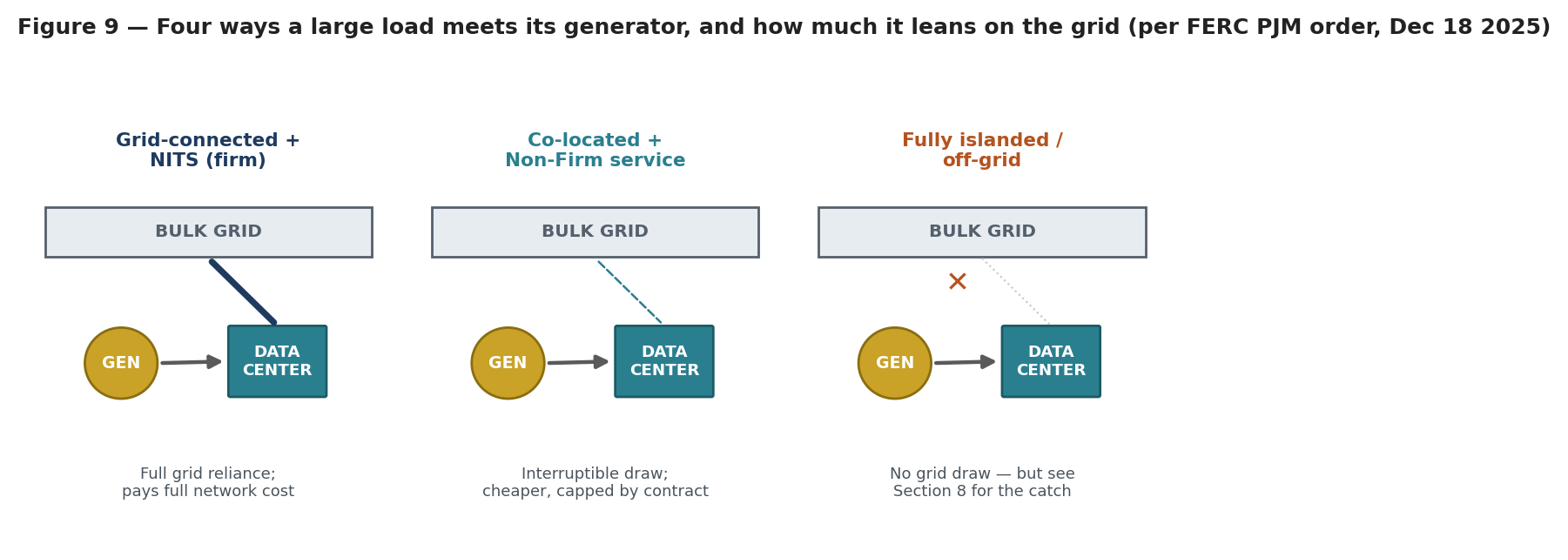
Figure 9 — The four supply configurations available to a large load, running from full grid reliance through co-location and behind-the-meter generation to complete islanding. The middle two matter most because they are where the regulatory question sits: how to price a connection that uses the system intermittently without paying for it as though it did so continuously. The fourth appears to escape the question entirely, and Section 8 sets out why it shifts many system impacts rather than eliminating them. A fifth arrangement sits outside the figure and has absorbed both of the largest nuclear transactions: full network service with a bilateral contract to an identified unit, which carries the commercial character of co-location and none of its system-impact character.